Acid Reflux and Hormones: Why Your GERD Gets Worse During Your Period
If you've ever noticed your acid reflux flaring right before your period — and then felt dismissed when you tried to explain the pattern — you're not imagining it. And you're not being dramatic.
There's a direct physiological connection between your hormones and your Lower Esophageal Sphincter (LES) — the little muscle that's supposed to keep stomach acid in your stomach. When your hormones shift, your LES pressure changes.
Your Hormones Are a Root Contributor to Reflux — Here's the Mechanism
Your LES is the muscular valve between your esophagus and stomach. When it contracts properly, it opens to let food down and closes tightly to prevent backflow. But your LES doesn't operate in isolation — it's influenced by hormones, nervous system state, diaphragmatic pressure, and more.
Both estrogen and progesterone affect smooth muscle tone throughout your body. Your LES is smooth muscle. So when these hormones fluctuate — during your menstrual cycle, pregnancy, or perimenopause — your LES pressure can drop, and reflux events increase.
This isn't random. This is physiology.
How Your Menstrual Cycle Affects Your LES
During the luteal phase — the 10 to 14 days before your period — progesterone levels rise significantly. Progesterone has an important job: it prepares the uterine lining for potential implantation. But it also relaxes smooth muscle everywhere, including your LES.
Research has shown that LES pressure decreases measurably during the high-progesterone phase of the menstrual cycle. That reduction in barrier pressure means your stomach contents have an easier path back up into your esophagus — and if you have LPR, into your throat.
If you've ever thought, "My reflux is worse the week before my period but nobody takes that seriously" — this is why. Your barrier mechanics are literally changing with your cycle.
What You Can Do During Your Cycle — And Why It Works
Once you understand the mechanism, you can build a strategy around it instead of feeling blindsided every month. Here's what we work on with clients who notice cyclical patterns:
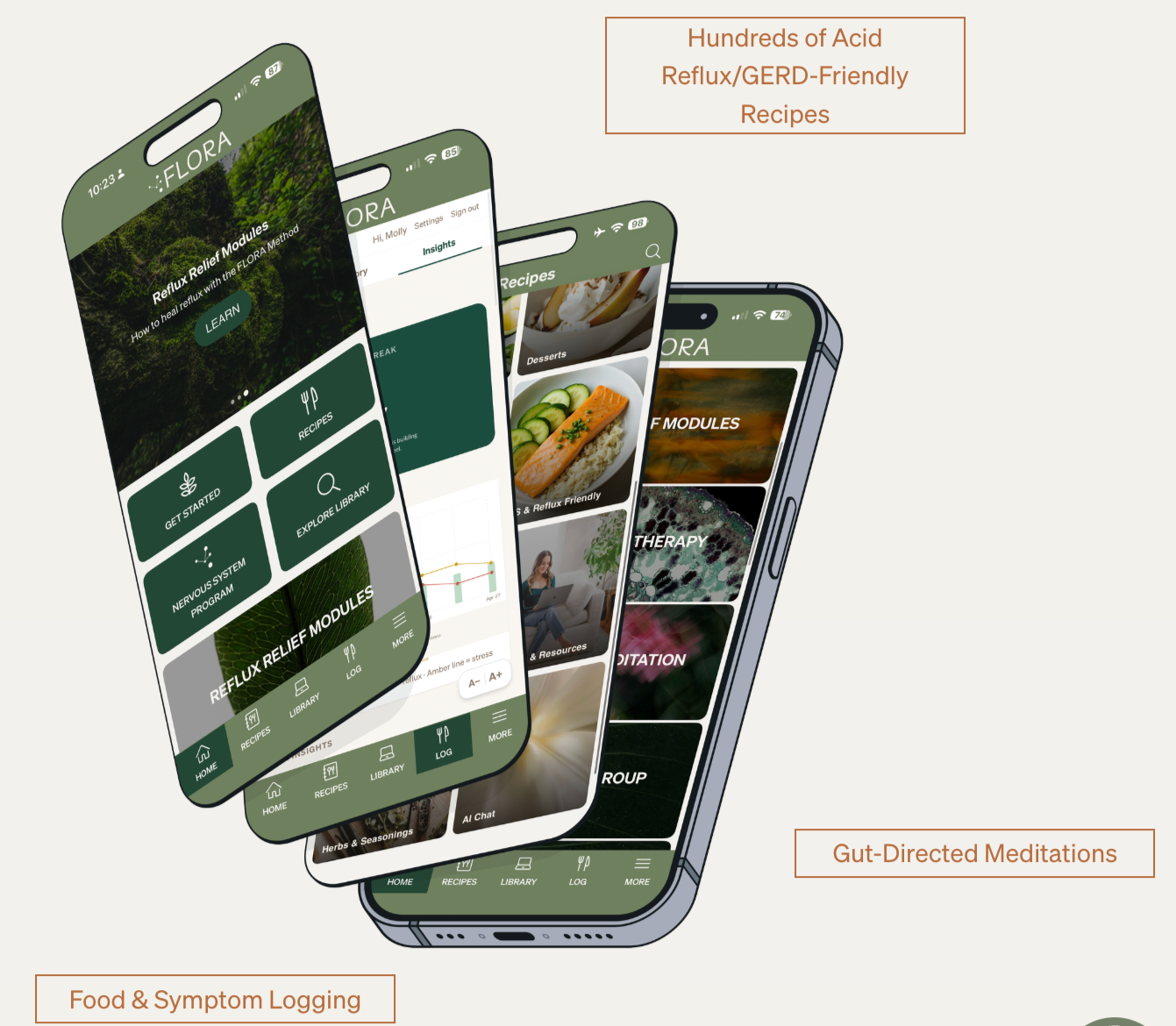
Track the pattern. Use the FLORA app to log symptoms alongside your cycle. When you can see the correlation — "my reflux spikes 3 days before my period, every single month" — you've gathered evidence. That evidence changes how you approach those days.
Add barrier support strategically. During your high-progesterone days, your LES pressure is lower. This is when alginate therapy does its most important work — it creates a physical raft on top of your stomach contents, blocking backflow even when LES pressure has dropped. The mechanism is mechanical, not hormonal, which is why it works alongside the hormonal shift rather than fighting it.
Adjust your meal architecture. Smaller, more frequent meals reduce gastric volume and intragastric pressure. When your LES is already under-supported by hormonal changes, reducing the pressure pushing against it from below makes a measurable difference.
Support progesterone metabolism. B6, magnesium, and zinc all play roles in how your body processes progesterone. This isn't about suppressing the hormone — it's about supporting the metabolic pathways that keep your hormonal shifts from overwhelming your barrier mechanics.
Birth Control and Reflux: A Root Contributor Your Doctor Probably Hasn't Mentioned
If your reflux started — or got noticeably worse — after beginning hormonal birth control, that's not a coincidence you should ignore.
Synthetic hormones in birth control pills affect smooth muscle tone, and your LES is directly in the crossfire. Combined pills with higher estrogen doses tend to have the most pronounced effect on LES pressure. This is the same mechanism as the menstrual cycle effect, but sustained.
This doesn't mean birth control is the "cause" of your reflux. Reflux has multiple, overlapping root contributors — LES integrity, motility, nervous system state, diet, and yes, hormones. But if hormonal birth control is one of your root contributors, your reflux protocol needs to account for it.
Some clients find relief by adjusting the timing of their pill. Others benefit from adding Sequoia Soothe — our alginate-based supplement — as barrier support during the days their LES pressure is most affected. The approach depends on your specific picture, which is exactly the kind of thing we map out together.
Pregnancy and Reflux: Why Up to 80% of Pregnant Women Experience It
During pregnancy, progesterone levels increase roughly 10-fold. Add the physical upward pressure from a growing baby compressing the stomach, and you've got two simultaneous forces working against your LES: hormonal relaxation and mechanical pressure.
Up to 80% of pregnant women experience reflux. That statistic makes complete sense when you understand the mechanism.
Understanding this mechanism matters because it changes what interventions are appropriate. Alginate-based supplements create a physical barrier — a raft that sits on top of stomach contents and blocks backflow without being absorbed systemically. That mechanical action makes alginate one of the most evidence-supported options during pregnancy, when systemic interventions carry more risk.
Perimenopause: Why Reflux Appears (or Gets Worse) in Your 40s
If reflux showed up seemingly out of nowhere in your 40s, you're not alone — and you're not doing anything wrong.
During perimenopause, estrogen doesn't just decline — it fluctuates unpredictably before it declines. Those fluctuations create inconsistent changes in LES pressure. One week your barrier holds, the next week it doesn't — and nothing else in your life has changed.
There's a second mechanism at play here too. Declining estrogen affects your esophageal mucosal barrier — the protective lining that shields your tissue from acid and pepsin damage. So during perimenopause, you're dealing with both reduced LES pressure and a less protected esophageal lining.
That dual mechanism explains why reflux can feel so much more aggressive during this transition — and why the "just take a PPI" approach often falls short. Acid suppression addresses one piece, but it doesn't rebuild the mucosal barrier or restore LES tone.
Working With Your Hormones — Not Against Them
The approach we use inside the FLORA method treats hormones as one of several root contributors — not as something to fear or fight. Here's what that looks like in practice:
Cycle-aware protocol adjustments. Your reflux protocol doesn't have to be the same every day of the month. During your high-progesterone days, you add barrier support and adjust meal timing. During lower-risk phases, you have more flexibility. This is strategic — not restrictive.
Targeted supplementation. Alginate therapy for barrier support. Zinc carnosine for mucosal healing. DGL for soothing irritated tissue. Each of these addresses a specific mechanism — they're tools in your protocol, not random additions.
Nervous system regulation. Stress amplifies every hormonal effect on your LES. When your nervous system is in fight-or-flight, blood flow shifts away from your gut, your diaphragm tightens, and your LES loses coordination. Diaphragmatic breathing — 5 to 10 minutes, immediately after meals, five times daily — strengthens the crural diaphragm and increases LES pressure. We call this the LES Lock, and it's one of the most effective tools we have.
Meal timing that respects your barrier. Earlier dinners and the 4-hour buffer (stopping all food and drink 3 hours before lying down) become even more important during high-hormone phases when your LES pressure is already reduced.
You're Not Imagining This — And You Don't Have to Just Push Through It
Your hormones and your reflux are connected. That's actually good news — because once you understand the mechanism, you can take strategic action instead of feeling blindsided by seemingly random flares.
You're not being dramatic. You're not overthinking it. Your body is responding to real physiological changes, and you deserve support that actually explains why.
If you're ready to build a reflux protocol that accounts for your hormonal patterns — not just your food diary — that's exactly what we map out inside the Reflux Relief Masterclass. We look at the full picture: barrier mechanics, nervous system state, meal architecture, supplementation, and yes — your hormones.
Small hinges swing big doors. Understanding this connection is one of them.
xo, Molly