How to Wean Off PPIs Safely: A Dietitian's Guide to Avoiding Acid Rebound
If you've ever tried to lower your PPI dose and felt your symptoms come roaring back worse than before, you are not imagining it, and it is not a sign that you'll be on these medications forever. That rebound has a name and a mechanism, and once you understand it, the whole process gets a lot less scary.
I've walked hundreds of clients through this, and I went through my own version of it too. So I want to share the approach I use, the research behind it, and the safeguards that matter most. One of those safeguards comes first: weaning off a proton pump inhibitor is something you do with your prescribing provider, never on your own. Think of what follows as the preparation and support that makes that conversation, and that taper, go better. This post does not intend to replace medical care. Always discuss with your health care provider before making changes to your medication.
Why PPI Rebound Happens (and Why It's Not Your Fault)
When you take a PPI for more than about 8 weeks, your body adapts to the lower acid environment. Acid suppression raises a hormone called gastrin, and over time elevated gastrin increases your stomach's acid-producing capacity, both the enterochromaffin-like cells that signal for acid and the parietal cells that produce it. This is called rebound acid hypersecretion, or RAHS.
Here's why it matters for you: when the medication comes off and that built-up capacity is still in place, acid output can temporarily run higher than where you started. So the surge of symptoms you feel when you drop a dose often isn't your original reflux returning at full force. It's this temporary, predictable rebound, and it fades as your system recalibrates.
The research here is solid. According to PubMed, a randomized, double-blind, placebo-controlled trial of 120 healthy volunteers with no reflux history found that 8 weeks of esomeprazole followed by withdrawal produced acid-related symptoms like heartburn and acid regurgitation in 44% of the PPI group during weeks 9 to 12, compared with 15% of the placebo group (Reimer et al., 2009, Gastroenterology, n=120, P<0.001, PMID: 19362552, DOI). People who had no acid symptoms to begin with developed them simply from stopping the drug. That's how real the rebound is.
We also have a sense of how long it lasts. In patients who had used a PPI daily for over a year, acid hypersecretion persisted beyond 8 weeks but had resolved by 26 weeks after stopping, and the effect involved both parietal cell and ECL cell mass (Fossmark et al., 2005, Alimentary Pharmacology & Therapeutics, PMID: 15679764, DOI). A later review confirmed that PPIs, unlike H2 blockers, drive a clinically meaningful rebound through this gastrin pathway (Waldum et al., 2010, Scandinavian Journal of Gastroenterology, PMID: 20001749, DOI).
Knowing this changes the strategy. The goal isn't to white-knuckle through the rebound. It's to taper slowly enough that your acid capacity downshifts gradually, while you support the mechanisms that keep acid where it belongs.
Before You Taper: Set the Foundation First
Before you and your provider lower a single milligram, spend 2 to 4 weeks building up your body's natural reflux defenses. These are strategic additions to a healing architecture, the things that give your esophagus more support as your acid levels find their new normal.
1. Support your lower esophageal sphincter (LES)
Your LES is the muscle that's supposed to keep stomach contents in your stomach, and the crural diaphragm wraps around it like a second layer of support. You can actively train that diaphragm. In a randomized controlled trial, GERD patients who did diaphragmatic breathing training cut the time their esophagus spent exposed to acid roughly in half, from 9.1% to 4.7% of the day, and the patients who kept the practice up reduced their PPI use at 9-month follow-up (Eherer et al., 2011, American Journal of Gastroenterology, n=19, P<0.05, PMID: 22146488, DOI).
Here's what I teach my clients as a bite-size version of this, something I call the LES Lock: 1 to 5 minutes of diaphragmatic breathing with 360-degree ribcage expansion, done immediately after meals, up to 5 times a day. Small, repeatable practices like this tend to be more achievable than a long daily session, and consistency is the secret sauce.

2. Add strategic, soothing support
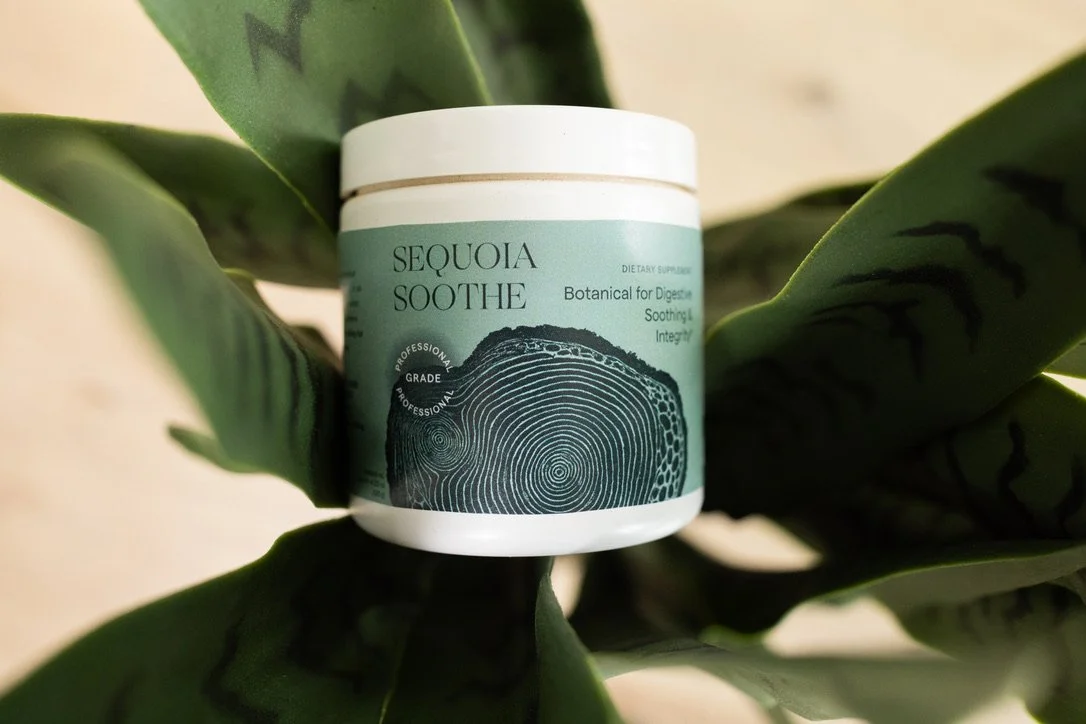
Demulcent botanicals like slippery elm form a viscous gel that physically coats and soothes irritated tissue in the upper GI tract. This is the thinking behind Sequoia Soothe, the powder I formulated with the ingredients I reach for in clinical practice: slippery elm and DGL to soothe and support mucosal tissue, L-glutamine for gut lining integrity, and zinc carnosine to support esophageal and gastric tissue. It's there to soothe irritation and support esophageal comfort while you do the deeper work, not to replace your medication. Consult your healthcare provider before starting any new supplement, especially if you're pregnant, nursing, or taking medications.
3. Adjust your eating architecture
Smaller, more frequent meals put less pressure on your LES than large ones. And give yourself a 3-hour buffer before bed: aim to finish eating about 3 hours before you lie down, so your stomach has time to empty before you're horizontal. Beverages are fine in that window. None of this is about restriction. It's about changing the conditions so your esophagus has fewer reasons to flare while you taper.
A Sample Tapering Framework
Here's the part most people don't get walked through. A taper works best when it's slow and stepwise, because your acid-producing capacity needs time to downshift after each reduction. In my clinical experience, a reduction of roughly 25% at a time, held for 2 to 4 weeks before the next step, gives the system room to adjust. Bridging the gaps with an H2 blocker is something some providers add, because H2 blockers don't carry the same rebound effect.
A sample step-down for 40mg omeprazole might look like:
Weeks 1 to 3: 40mg daily
Weeks 4 to 6: 30mg daily
Weeks 7 to 9: 20mg daily
Weeks 10 to 12: 20mg every other day
Weeks 13 to 15: 10mg daily
Weeks 16 to 18: 10mg every other day
Week 19 and beyond: discontinue, with your provider's sign-off
Yes, this takes months. That patience is exactly what prevents the rebound from derailing you. This is a general framework to bring to your prescriber, not a prescription. Your dose, your starting point, and your timeline belong to you and your provider together.
Managing Flare Days (They Will Happen)
A rough reflux day during a taper isn't failure. It's information. When a flare shows up, it's worth asking a few honest questions: Did the last dose reduction happen too fast? Has stress been running high? Are you keeping up the LES Lock and your eating architecture? Was last night's dinner large or late?
This is where tracking earns its keep. Logging your symptoms, meals, medications, supplements, and daily habits in the FLORA App Reflux Clarity Log helps you and your provider see the pattern instead of guessing at it. Sometimes the answer is simply to hold at your current dose for an extra week before stepping down again. That isn't going backward. That's reading your data and responding to it.
When You Want More Support
If you've tried to come off PPIs before and the rebound kept pulling you back, you don't have to figure this out alone. The Reflux Relief Masterclass walks you through the full approach, including how to address the root contributors behind your reflux and how to build a taper plan you can take to your doctor with confidence. And for complex or stubborn cases, working together one-on-one lets us map a plan around your specific history and symptoms.
Your body knew how to regulate acid before PPIs, and the capacity to do that again is still there. Our work is to support it through the transition so the rebound doesn't get the final word.
You've got this. And I'm here to help.
With love,
Molly Pelletier, MS, RD