What to Look For in a Supplement for Acid Reflux and LPR: A Dietitian's Guide
Quick answer: what makes a good reflux supplement?
When you're choosing a supplement for acid reflux or LPR, look for two things working together. First, an immediate soothing ingredient like slippery elm, which coats the throat and esophagus on contact. Second, lining-support ingredients like L-glutamine, DGL, and zinc carnosine that support the integrity of your mucosal barrier over time. Then check three practical things: clinically meaningful doses listed transparently on the label, a powder form so the soothing ingredient actually reaches your tissue, and a formula free of common reflux triggers and fillers. Soothing alone is temporary. Lining support alone is slow. The combination is what you're looking for.
If you've searched "best supplement for acid reflux," you already know the problem. There are hundreds of options, every label promises "digestive comfort," and almost none of them explain what the ingredients actually do in your body. So you're left guessing, again.
I want to give you a framework instead. As a registered dietitian who works with GERD and LPR every day, here's how I evaluate a reflux supplement, and what I want you to look for before you spend a dollar.
First, Understand What You're Asking A Supplement To Do
Reflux has multiple root contributors. The tone of your lower esophageal sphincter (LES), the crural diaphragm, your nervous system state, motility, hormones, and diet all play a role, and a supplement doesn't address all of them. So a supplement is a strategic addition to your healing phase, not the whole plan.
What a well-built reflux supplement can do is support the tissue that takes the brunt of reflux: the lining of your throat, esophagus, and stomach. That lining is your barrier. When it's well supported, it's more comfortable and more resilient day to day. That's the job to look for.
Look For A Soothe-And-Support Approach
Most products pick one lane. The strongest formulas do two things at once.
Immediate soothing (the coating layer). Slippery elm is a demulcent, meaning it forms a soothing film over mucous membranes. Mixed with water it produces a thick mucilage that coats tissue as you drink it. A 2019 critical appraisal in Current Gastroenterology Reports (Ahuja & Ahuja, PMID 31289950) included slippery elm among the complementary options reviewed for esophageal symptoms, based on this demulcent mechanism. This is also why form matters, which I'll come back to.
Lining Support Over Time (The Support Layer). This Is What Soothing Alone Misses.
- L-glutamine is the primary fuel source for the cells that line your gut. A review in Current Opinion in Clinical Nutrition and Metabolic Care (Achamrah et al., 2017, PMID 27749689) described glutamine as a major nutrient for maintaining intestinal barrier function.
- DGL (deglycyrrhizinated licorice) supports the protective mucus layer over your lining. Research in the European Journal of Pharmacology (van Marle et al., 1981, PMID 7250207) found DGL stimulates mucus-secreting cells and accelerates mucus formation.
- Zinc carnosine supports the stability of the gastric lining. A randomized crossover trial in Gut (Mahmood et al., 2007, PMID 16777920) found that co-administering zinc carnosine kept gut permeability normal in volunteers taking an NSAID, while the control group saw a threefold increase.
Soothing gives you comfort now. The barrier-support ingredients give your body raw materials to support its lining over weeks. You want both.
Where Alginates Fit (And How They're Different)
You'll see alginates recommended for reflux, and they have a real, useful role. Alginates are seaweed-derived and form a physical raft on top of your stomach contents, which can help block backflow after meals or before bed. That's Alginate Therapy, and it's a barrier strategy I use. A 2017 systematic review and meta-analysis in Diseases of the Esophagus (Leiman et al., PMID 28375448) of 14 randomized trials (2,095 people) found alginate-based therapy resolved GERD symptoms significantly more often than placebo or antacids.
But an alginate raft is a different mechanism from a coating-and-support formula. One sits on your stomach contents to reduce backflow in the moment. The other soothes the tissue itself and supports the lining over time. Many people benefit from both, used for different jobs. The point is to know which job you're solving for, rather than assuming every "reflux supplement" does the same thing.
Three Practical Checks Before You Buy
1. Doses you can actually see. Look for the milligram amount of each active ingredient on the label, not a hidden "proprietary blend." A token sprinkle of slippery elm or glutamine won't do much. Clinically meaningful doses are the difference.
2. The right form. A coating ingredient like slippery elm can't coat anything from inside a capsule that dissolves in your stomach. A powder mixed in water lets the soothing layer reach your throat and esophagus as you drink it.
3. Clean of common triggers. Check for added citrus or mint flavoring, artificial sweeteners, and fillers that can stir up symptoms in a sensitive system. Third-party testing is a green flag for purity.
How I Put This Into One Formula
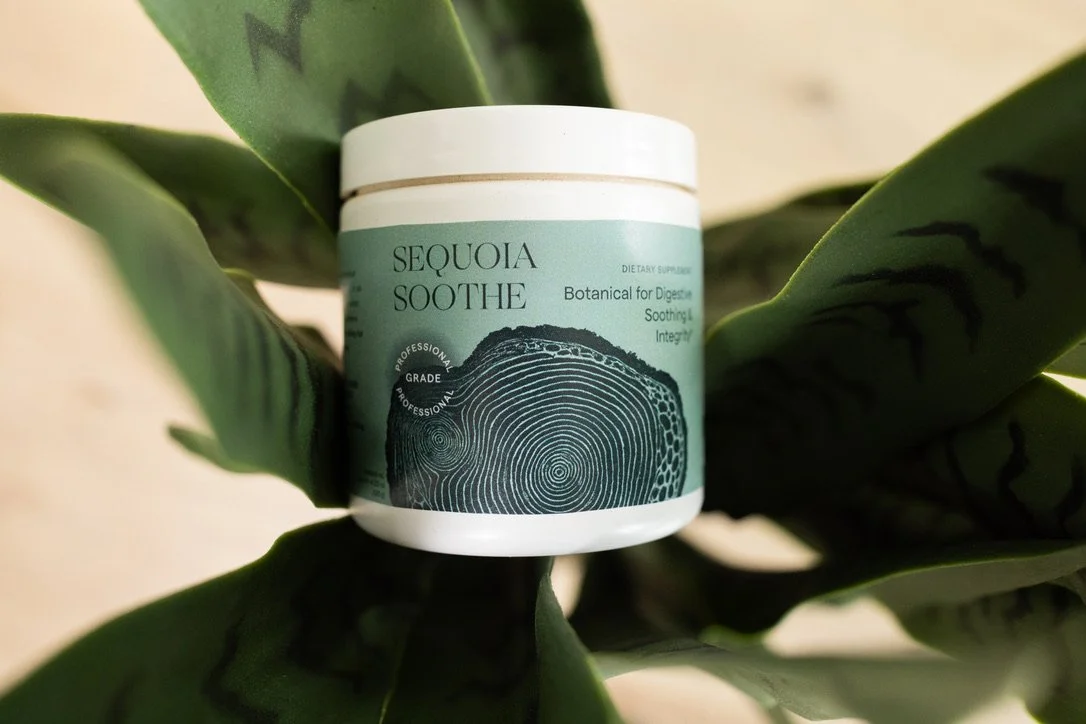
These are the exact principles I built into Sequoia Soothe, the professional-grade botanical powder I use with my own clients. It pairs a soothing demulcent with barrier-support ingredients, at doses listed transparently on the label, in a powder you mix in water, free of common reflux triggers and third-party tested. It's a strategic addition to the barrier and nervous system work, not a replacement for your medications or your protocol.
The Bigger Picture
A supplement is one piece. The reason the same meal can feel fine one day and awful the next is that your nervous system, your LES support, and your barrier are all part of the picture too. That full architecture is exactly what we map out together inside the Reflux Relief Masterclass, so you're not guessing your way through this one product at a time.
You deserve support that actually explains why.
With love,
Molly Pelletier, MS, RD

References
- Ahuja A, Ahuja NK. Popular remedies for esophageal symptoms: a critical appraisal. Current Gastroenterology Reports. 2019;21(8):39. PMID: 31289950. https://www.google.com/url?q=https://doi.org/10.1007/s11894-019-0707-4&source=gmail&ust=1781631771609000&sa=E
- Achamrah N, Dechelotte P, Coeffier M. Glutamine and the regulation of intestinal permeability: from bench to bedside. Current Opinion in Clinical Nutrition and Metabolic Care. 2017;20(1):86-91. PMID: 27749689. https://www.google.com/url?q=https://doi.org/10.1097/MCO.0000000000000339&source=gmail&ust=1781631771609000&sa=E
- van Marle J, Aarsen PN, Lind A, van Weeren-Kramer J. Deglycyrrhizinised liquorice (DGL) and the renewal of rat stomach epithelium. European Journal of Pharmacology. 1981;72(2-3):219-225. PMID: 7250207. https://www.google.com/url?q=https://doi.org/10.1016/0014-2999(81)90276-4&source=gmail&ust=1781631771609000&sa=E
- Mahmood A, FitzGerald AJ, Marchbank T, et al. Zinc carnosine, a health food supplement that stabilises small bowel integrity and stimulates gut repair processes. Gut. 2007;56(2):168-175. PMID: 16777920. https://www.google.com/url?q=https://doi.org/10.1136/gut.2006.099929&source=gmail&ust=1781631771609000&sa=E
- Leiman DA, Riff BP, Morgan S, et al. Alginate therapy is effective treatment for GERD symptoms: a systematic review and meta-analysis. Diseases of the Esophagus. 2017;30(5):1-9. PMID: 28375448. https://www.google.com/url?q=https://doi.org/10.1093/dote/dow020&source=gmail&ust=1781631771609000&sa=E
Frequently Asked Questions
What is the best supplement for acid reflux?
The best supplement pairs two things: an immediate soothing ingredient like slippery elm that coats the throat and esophagus, and lining support ingredients like L glutamine, DGL, and zinc carnosine that support your mucosal barrier over time. Look for clinically meaningful doses listed on the label and a formula free of common triggers and fillers.
Should a reflux supplement be a powder or a capsule?
Powder. A coating ingredient like slippery elm needs to make contact with your throat and esophagus as you drink it. Inside a capsule, it dissolves in your stomach and never reaches the tissue it's meant to soothe.
What dose of slippery elm or DGL should I look for?
Check that the milligram amount of each active ingredient is listed clearly on the label, not hidden inside a proprietary blend. A small amount of slippery elm or DGL won't have much effect; clinically meaningful doses are what make the difference
Are alginates the same as a soothing supplement?
No. Alginates form a physical raft on top of your stomach contents to block backflow, while a soothing supplement coats and supports the tissue itself. They work through different mechanisms, and many people benefit from using both for their separate jobs.