If you have had a cough for more than eight weeks, a clear chest X-ray, and no heartburn to speak of, you have probably been told some version of "everything looks normal." Your cough is real, and silent reflux, also called LPR (laryngopharyngeal reflux), is one possible driver that gets missed. In a 2026 review, up to 75% of people with reflux-related cough had no heartburn or regurgitation (Fass and Yadlapati, 2026).
Rule out other causes first
A cough that lasts more than eight weeks deserves a full workup. In the CHEST guideline review, asthma and upper airway cough syndrome (the cough that comes from nose and sinus problems, once called postnasal drip syndrome) were the most commonly reported causes, and reflux can sit alongside them (Kahrilas et al., 2016). See your doctor promptly if you cough up blood, have trouble swallowing, feel short of breath, or notice your cough getting worse.
What is silent reflux, and why no heartburn?
Silent reflux is reflux that reaches the throat and voice box without the burning most people expect. Throat and larynx tissue has different defenses and a different damage threshold than the esophagus (Koufman and Johnston, 2012), so exposure that never registers as heartburn can still irritate it. It tends to show up as a cough, throat clearing, or a sensation of something stuck.
Three ways reflux keeps a cough going
Researchers describe two pathways, plus a third factor that turns the volume up (Fass and Yadlapati, 2026).
Direct contact. Refluxate reaches the throat and larynx. Pepsin, the enzyme from your stomach that travels up with refluxate, stays stable at near-neutral pH and switches back on whenever acid reaches it (Koufman and Johnston, 2012). An irritated throat coughs more easily.
The vagal cough reflex. Reflux that stays lower in the esophagus can still set off a cough through the vagus nerve, the gut-brain communication line. This is called the esophageal-tracheobronchial reflex, and it is one reason a reflux cough can show up without any reflux reaching your throat.
A cough reflex that has become oversensitive. Cough hypersensitivity amplifies your response to reflux and can keep the cough going even when reflux treatment is in place.
The cough-reflux cycle
Each cough spikes the pressure inside your abdomen. Reflux gets past the LES (the lower esophageal sphincter, the valve between your stomach and esophagus) when pressure in the stomach beats the pressure holding the valve closed. In the Mayo Clinic breathing trial, a Valsalva strain produced reflux in 65% of patients with GERD, and stomach pressure after a meal was higher in patients than in controls (12 vs 7 mm Hg) (Halland et al., 2021). More reflux means more irritation, more irritation means more coughing, and the loop keeps running. Those pressure data come from a strain maneuver, not from coughing itself, so the loop as a whole is the working model I use with clients.
Why acid blockers alone often fall short
Proton pump inhibitors (PPIs) lower stomach acid. They do not modify the reflux barrier (Surdea-Blaga et al., 2019), and they do not address the vagal reflex or a cough reflex that has become oversensitive. A 2024 meta-analysis of 11 placebo-controlled trials found PPIs lowered chronic cough severity only slightly, and the certainty of that evidence was low (Floria et al., 2024). The CHEST guideline panel found PPIs showed no benefit when used in isolation (Kahrilas et al., 2016). Talk to your doctor before you change any medication. What I add alongside it targets the pressure and the nervous system.
What helps
My approach is additive: tools you add to your day, with no new food rules. These are the four I use for a reflux cough.
Support the LES with the LES Lock. Do 1 to 5 minutes of diaphragmatic breathing with 360 ribcage expansion (breathe into the front, sides, and back of your ribs) right after meals, up to 5 times a day. In the Mayo trial, LES pressure rose with every inhale (42 vs 23 mm Hg), and reflux events after a meal averaged 0.36 with breathing vs 2.60 without it, in 23 patients with GERD (Halland et al., 2021). In a separate randomized trial of 19 people, 4 weeks of breathing training cut the time the esophagus spent below pH 4 from 9.1% to 4.7% (Eherer et al., 2012). Both studies are small, so I treat them as a reason to practice, not a guarantee. The second trial excluded people with large hiatal hernias, so check with your provider first if you have one.
Calm your nervous system. In a case-control study of 45 people with LPR and 29 controls, anxiety and perceived stress were higher in the LPR group (Barillari et al., 2025). That is an association from a small, preliminary study, and the authors describe a possible vicious cycle, so I treat the nervous system as part of the plan. Extended exhales are the part I coach most: breathe out slower than you breathe in, which is the easiest way I know to cue your body toward rest-and-digest.
Use the 3-Hour Buffer. Stop eating 3 hours before bed. In a prospective study of 337 adults, people with GERD who went to sleep within 3 hours of dinner were more likely to have it come back (Yang et al., 2014). Water is fine.
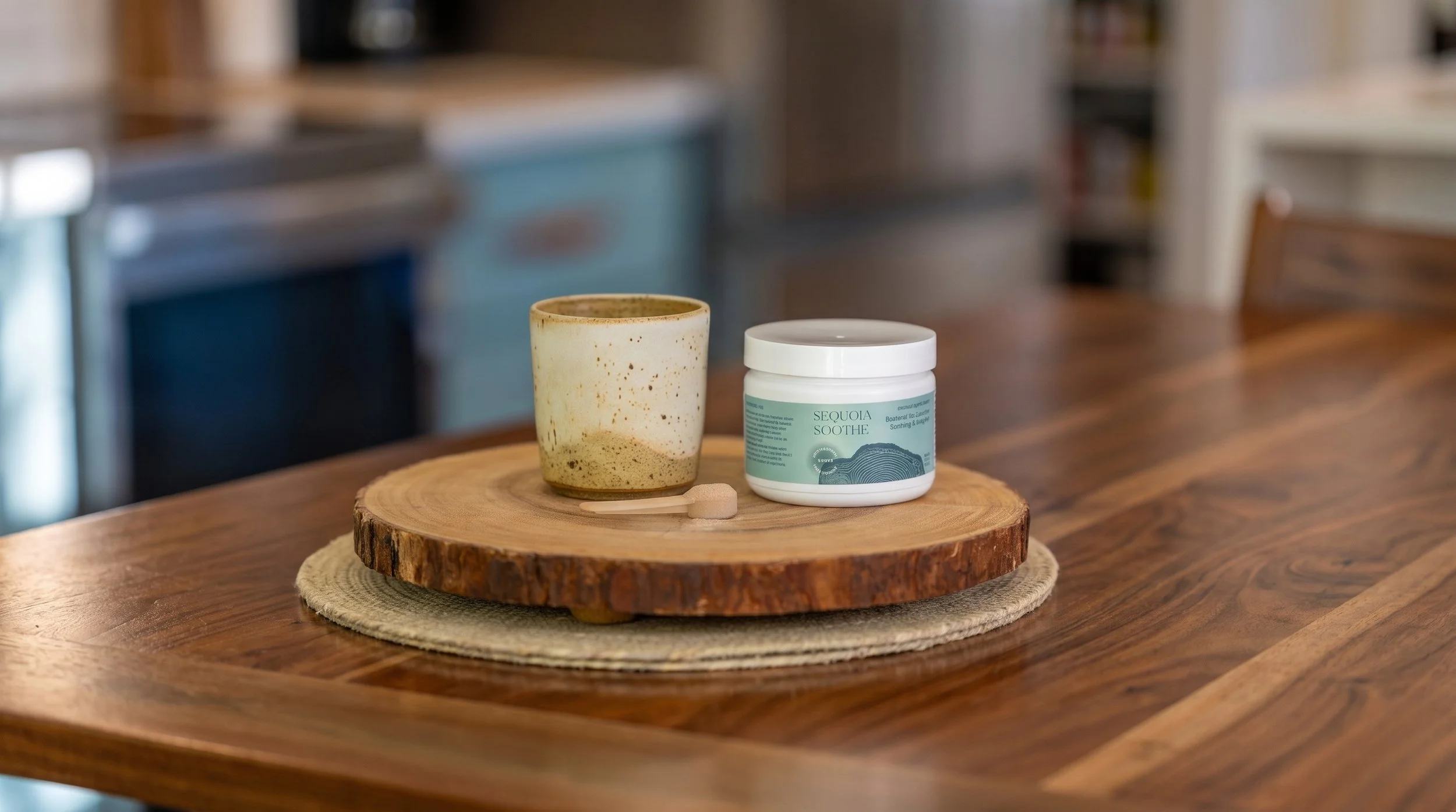
Soothe the irritated tissue. Mucilaginous herbs like slippery elm soothe the throat and esophagus on the way down. I used slippery elm through my own healing and later built it into Sequoia Soothe.
When to get support
If your cough has outlasted every cough syrup and your tests keep coming back normal, breaking the cycle usually takes more than one tool. That is why our team works on all four at once with clients: lowering reflux events, supporting the LES, calming the nervous system, and soothing the tissue.
Ready to figure out what is driving your cough? Apply to work 1:1 with our expert team of reflux Dietitians. You can also read more about silent reflux and LPR on the FLORA blog.
With love,
Molly Pelletier, MS, RD

References
Fass OZ, Yadlapati RH. Diagnostic and management approach to reflux-related cough. Gastroenterology & Hepatology (N Y), 2026;22(1):31-42. Narrative review. PMID: 41646078.
Kahrilas PJ, Altman KW, Chang AB, et al. Chronic cough due to gastroesophageal reflux in adults: CHEST guideline and expert panel report. Chest, 2016;150(6):1341-1360. Systematic review and guideline. PMID: 27614002. DOI
Koufman JA, Johnston N. Potential benefits of pH 8.8 alkaline drinking water as an adjunct in the treatment of reflux disease. Annals of Otology, Rhinology & Laryngology, 2012;121(7):431-434. In vitro laboratory study. PMID: 22844861. DOI
Halland M, Bharucha AE, Crowell MD, Ravi K, Katzka DA. Effects of diaphragmatic breathing on the pathophysiology and treatment of upright gastroesophageal reflux: a randomized controlled trial. American Journal of Gastroenterology, 2021;116(1):86-94. Mayo Clinic. Randomized controlled trial, n=33 (23 patients, 10 controls). PMID: 33009052. DOI
Surdea-Blaga T, Negrutiu DE, Palage M, Dumitrascu DL. Food and gastroesophageal reflux disease. Current Medicinal Chemistry, 2019;26(19):3497-3511. Review. PMID: 28521699. DOI
Floria DE, Obeidat M, Kavasi SB, et al. Systematic review and meta-analysis: proton pump inhibitors slightly decrease the severity of chronic cough. Scientific Reports, 2024;14(1):11956. 11 placebo-controlled randomized trials (9 reported cough severity, n=351); GRADE certainty low. PMID: 38796481. DOI
Eherer AJ, Netolitzky F, Hogenauer C, et al. Positive effect of abdominal breathing exercise on gastroesophageal reflux disease: a randomized, controlled study. American Journal of Gastroenterology, 2012;107(3):372-378. Randomized controlled trial, n=19. PMID: 22146488. DOI
Barillari MR, Giordano GM, Costa G, et al. Laryngopharyngeal reflux and psychological distress: a vicious cycle worth investigating. European Archives of Oto-Rhino-Laryngology, 2025;282(6):3103-3113. Case-control, 45 LPR patients vs 29 controls. PMID: 40258993. DOI
Yang JH, Kang HS, Lee SY, et al. Recurrence of gastroesophageal reflux disease correlated with a short dinner-to-bedtime interval. Journal of Gastroenterology and Hepatology, 2014;29(4):730-735. Prospective study, n=337. PMID: 24224689. DOI
This post is for educational purposes only and is not a substitute for personalized medical advice. Always consult your healthcare team before making changes to your routine.