If you have silent reflux, you have probably been handed a list of everything you can't eat: coffee, tomatoes, citrus, chocolate, wine, and a dozen more. And if you've been living on that list for a while, I'm guessing you're hungry, frustrated, and still clearing your throat. I know because I lived it. I struggled with reflux for over a decade, and I spent a lot of that time searching for the next trigger and cutting food after food.
So this post goes the other direction. This is what we actually put on the plate during an LPR healing phase, based on my own experience, the research, and the work our team does with clients in our private practice. You'll find the plate formula we use, a full day of meals you can copy, and the step-by-step way we bring your favorite foods back once your throat has calmed down.
Why food matters so much for silent reflux
Silent reflux, or LPR (laryngopharyngeal reflux), is reflux that reaches your throat and voice box, often without the heartburn most people expect. A big part of the story is pepsin, the enzyme your stomach uses to break down protein. When stomach contents travel upward, pepsin can travel with them and settle into the tissue of your throat. Even between reflux episodes, that tissue-bound pepsin can keep the irritation going, which is where the throat clearing, cough, hoarseness, post-nasal drip, and extra mucus come from.
Pepsin is switched on by acid. Human pepsin stays stable at near-neutral pH and becomes active again whenever acid reaches it (Koufman and Johnston, 2012). That means the acidity of what you eat and drink can reactivate the pepsin already sitting in your throat. It's also why a PPI (proton pump inhibitor) alone often doesn't resolve LPR. A PPI lowers the acid your stomach makes, but it doesn't change the acidity of your food or stop pepsin from reaching your throat.
Here is what the research shows:
A low-acid diet for stubborn LPR: Dr. Jamie Koufman followed 20 people whose symptoms persisted despite twice-daily PPIs plus an H2 blocker at bedtime. After removing foods and drinks below pH 5 for at least two weeks, 19 of the 20 improved (Koufman, 2011). It's a small study without a control group, so I treat it as a strong signal, not proof.
A Mediterranean-style diet with alkaline water: In a retrospective chart review of 184 people with LPR, 99 were treated with alkaline water, a 90% plant-based Mediterranean-style diet, and standard reflux precautions, and 85 were treated with a PPI and the same precautions. After 6 weeks, 62.6% of the diet group and 54.1% of the PPI group had a clinically meaningful drop in symptom scores, and the average drop was larger in the diet group (Zalvan et al., 2017). The diet group did at least as well as the PPI group, without medication.
Alkaline water and pepsin: In a lab study, pH 8.8 alkaline water permanently inactivated human pepsin, while typical bottled waters did not (Koufman and Johnston, 2012). This was done in a test tube, not in people, so alkaline water is one supportive tool in our plan rather than the plan itself.
PPIs and throat symptoms: A meta-analysis of 72 studies and 5,781 LPR patients found PPIs were only mildly better than placebo, and the authors pointed to diet as an important addition to treatment (Lechien et al., 2019).
None of this means a PPI is wrong for you. Plenty of people need one for a period of time, and any change to your medication belongs in an honest conversation with your doctor. What the research does tell us is that food is one of the most useful tools we have for the throat.
The 3-month healing phase
Inside our practice, we use food within what I call a 3-month healing phase. Your timeline depends on how long you've had LPR and how your body responds, and many of our clients work with us for 3 to 6 months. Reflux usually has several root contributors, so the healing phase rests on five pillars:
Low-acid eating: We pause foods and drinks below about pH 5 so pepsin in the throat stays switched off and the tissue has time to recover.
Mediterranean-style meals: Restriction on its own leaves you undernourished, so every day still includes plenty of low-acid vegetables, fruit, fiber, and healthy fats.
Lifestyle and LES support: How you eat, when you eat, and supporting your LES (the lower esophageal sphincter, the valve between your stomach and esophagus) all reduce how much reflux reaches your throat in the first place.
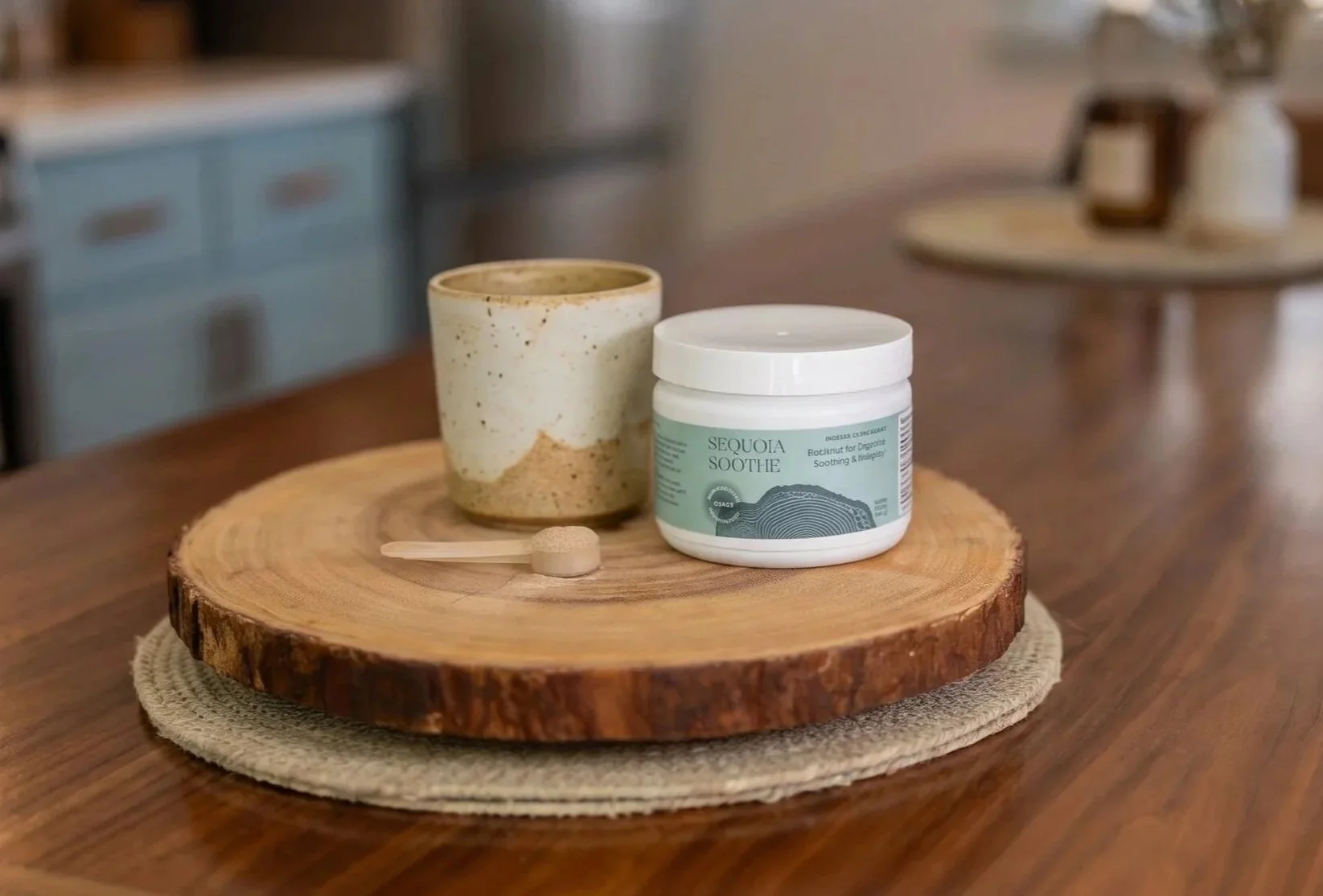
Strategic supplementation: An alginate like Reflux Raft, taken after meals, forms a raft on top of your stomach contents. Mucilaginous herbs like slippery elm soothe the throat and esophagus on the way down. I used slippery elm through my own healing and later built it into Sequoia Soothe.
Vagus nerve support: Your vagus nerve, the gut-brain communication line, helps regulate motility (how food moves through your digestive tract) and how sensitive the nerves in your throat and esophagus are to symptoms.
What to eat: the LPR plate formula
Your exact plate depends on your activity level and your goals. The structure, though, stays the same for almost everyone we work with:
Half the plate, low-acid vegetables: green beans, asparagus, zucchini, carrots, sugar snap peas, broccoli, arugula. These add fiber and volume to the meal without reactivating pepsin. They can show up at breakfast too, like arugula folded into eggs or melon next to your overnight oats.
A quarter, lean protein: salmon, cod, turkey, tofu, beans, or lean ground beef. We usually aim for 20 to 40 grams per meal, depending on your needs. Leaner proteins empty from the stomach more easily than very fatty cuts.
A quarter, high-fiber carbohydrates: potatoes, rice, quinoa, whole grain bread, or sourdough, for steady energy and fiber.
A little healthy fat: olive oil, avocado, nuts, and seeds. Many people with LPR cut fat completely, and I don't recommend it. Fat helps you absorb vitamins and supports hormone function, and nuts and seeds are an easy source of vitamin E.
Fruit is where a lot of our clients get nervous, and many arrive having cut it out completely. Early in your healing phase, start with the lowest-acid options: papaya, cantaloupe, honeydew, banana, watermelon, and Bosc pears. As you heal, we expand into stone fruits like peaches and plums and try a few blueberries in your oatmeal. If something like raspberries or kiwi burns on contact, your throat tissue probably needs more time while pepsin settles down and the tissue regenerates.
Flavor can come from herbs instead of acid. Fresh or dried cilantro, dill, parsley, thyme, and rosemary make roasted vegetables taste great, and the FLORA App has acid-free dressings and sauces. Oatmeal and flax meal are easy ways to add soluble fiber.
Coffee is personal. If it gives you instant throat irritation, pausing it during your healing phase can make a real difference. If you keep it, choose a low-acid coffee and always have it with food.

A full day of eating for silent reflux
I like to front-load the day, which means eating about 75% of your food before 5 p.m. Smaller, more frequent meals work well for many people with reflux, and eating more earlier leaves less in your stomach by evening, when you're closer to lying down.
Breakfast: high-protein chia seed pudding made with pea protein and topped with fresh banana. The chia adds fiber.
Mid-morning snack: a banana and about a quarter cup of almonds.
Lunch, the largest meal: wild salmon with breadcrumbs, roasted broccoli, green beans, and potatoes seasoned with salt, thyme, and dried sage. Protein, carbs, and plants.
Afternoon snack: baby carrots with the herbed chickpea dip from the FLORA App, for something crunchy.
Afternoon throat support: Sequoia Soothe stirred into a little water, with honey or maple syrup if you like.
Dinner, kept light: lean ground turkey with rice and sautéed vegetables, a little coconut aminos, black beans, sesame seeds, and a sprinkle of parmesan.
Evening sweet: toasted whole wheat or sourdough with raw honey and a pinch of flaky salt.
How you eat matters as much as what you eat. I call this Mealtime Mindfulness: give yourself a real 10 to 20 minute meal and chew to about applesauce consistency. When you slow down, your stomach can accept the food, contract, and move it down, instead of everything piling up at the top of your stomach like a traffic jam and pressing on the LES.
Threshold Testing: bringing your favorite foods back
A low-acid healing phase is meant to end. Healing doesn't run on a fixed schedule, though. Your body is not Amazon Prime, so if it takes longer than three months, that's okay. When your symptoms sit around a 0 to 2 out of 10, meaning reflux is rare, mild, and you usually know why it happened, it may be time to start Threshold Testing. Your threshold is the amount of a food you can enjoy without triggering symptoms.
Make your list: write down every food you've removed, then reorder it from least scary to most scary. Plums, blueberries, or tea might sit near the top. Spicy food, very acidic foods, and alcohol usually land at the bottom.
Start small: one or two bites, earlier in the day, after a few minutes of diaphragmatic breathing. Skip testing right before bed or after a big dinner.
Keep your tools nearby: have your alginate and Sequoia Soothe on hand in case you go past your threshold.
Increase gradually: a couple of fresh cherry tomatoes in a salad, then three the next time, then five. Where you land is your threshold.
Every test is an experiment, and a reaction is information about where your threshold sits today. When I first put my reflux into remission and came off PPIs, coffee still caused throat and chest burning. After 6 to 8 months, my tissue was more resilient. Now I can have one or two cups without a problem, and a third cup is where my throat starts to notice.
For coffee, test it like any other food: start with about 4 ounces of low-acid decaf, add some milk, almond milk, or oat milk to buffer the acidity, and always have it with food.
It's okay to miss the foods you've paused. Keep your list. We'll use it.
Where to start this week
Build one meal this week using the plate formula: half low-acid vegetables, a quarter lean protein, a quarter high-fiber carbs, and a little healthy fat. Then sit down for it, give yourself at least 10 minutes, and chew slowly.
If you want a healing phase built around your symptoms, and a Threshold Testing order built around the foods you miss most, that's exactly what our team maps out with clients.
Apply to work 1:1 with our expert team of reflux Dietitians → You can also find 300+ reflux-friendly recipes, including the meals in this post, in the FLORA App.
With love,
Molly Pelletier, MS, RD

References
Koufman JA. Low-acid diet for recalcitrant laryngopharyngeal reflux: therapeutic benefits and their implications. Annals of Otology, Rhinology & Laryngology, 2011;120(5):281-287. Prospective study, n=20. PMID: 21675582. DOI
Zalvan CH, Hu S, Greenberg B, Geliebter J. A comparison of alkaline water and Mediterranean diet vs proton pump inhibition for treatment of laryngopharyngeal reflux. JAMA Otolaryngology–Head & Neck Surgery, 2017;143(10):1023-1029. Retrospective chart review, n=184. PMID: 28880991. DOI
Koufman JA, Johnston N. Potential benefits of pH 8.8 alkaline drinking water as an adjunct in the treatment of reflux disease. Annals of Otology, Rhinology & Laryngology, 2012;121(7):431-434. In vitro laboratory study. PMID: 22844861. DOI
Lechien JR, Saussez S, Schindler A, et al. Clinical outcomes of laryngopharyngeal reflux treatment: a systematic review and meta-analysis. The Laryngoscope, 2019;129(5):1174-1187. Systematic review and meta-analysis, 72 studies, 5,781 patients. PMID: 30597577. DOI
This post is for educational purposes only and is not a substitute for personalized medical advice. Never stop or change a medication without talking to your doctor.