Why PPIs Don't Work for LPR: The Pepsin Explanation Your Doctor Skipped
Short answer: PPIs lower stomach acid. They do not remove pepsin, the stomach enzyme that travels up with refluxate and damages throat tissue even when the reflux is not acidic. That is why so many people with LPR (silent reflux) take a PPI faithfully and still have a raw throat, a hoarse voice, and constant throat clearing. In the largest placebo-controlled PPI trial for reflux-related throat symptoms, the main symptom resolved in under 15% of patients, the same as placebo. In Episode 38 of the Reflux Revolution Podcast, pepsin researcher Dr. Nikki Johnston and I walk through why, and what to do about it.
If you are still symptomatic on a PPI, you are not doing it wrong
You take it 30 minutes before breakfast, same time every day. You cut the coffee and the tomatoes. You stopped eating late. And your throat is still raw, your voice still cracks by the afternoon, and you are still clearing your throat a dozen times before lunch.
I hear this in almost every LPR intake, and I want to say it plainly: you did not fail the medication. For a lot of people with laryngopharyngeal reflux, acid was never the whole story, and once you see the mechanism, the "why isn't this working" question finally has an answer.
That is exactly why I asked Dr. Nikki Johnston onto the podcast. She runs a research lab at the Medical College of Wisconsin and has spent her career studying pepsin's role in reflux injury. Her work is the reason we talk about pepsin at all.
What do PPIs actually do?
Short answer: PPIs (proton pump inhibitors) reduce how much acid your stomach makes. They do not stop reflux from happening, and they do not remove what else is in the refluxate.
For classic heartburn and acid-driven GERD, lowering acid can be a real help, and this is not an anti-PPI post. Medication decisions belong between you and your care team, and a PPI has a legitimate place in a lot of plans.
Here is the gap. Stomach contents can still move upward on a PPI. The reflux is less acidic, so the esophagus often feels better, but the volume of what comes up has not changed. And that refluxate carries something acid suppression does not touch.
What is pepsin, and why is it the missing piece in LPR?
Short answer: Pepsin is the stomach's protein-digesting enzyme. It rides up with refluxate, sticks to throat tissue, and stays there. Your stomach lining is built to handle it. Your larynx is not.
Pepsin is switched fully on around pH 2 and appears inactive above pH 6.5. That sounds reassuring until you read the rest of the finding: pepsin stays stable for at least 24 hours at neutral pH, and when the pH drops again it regains most of its activity, about 79% (Johnston et al., 2007, The Laryngoscope, PMID: 17417109, DOI). So a single reflux event overnight can leave pepsin sitting in the throat, waiting. The next acidic thing that comes through, an orange, a coffee, a sparkling water, switches it back on.
It gets more specific. Dr. Johnston's lab showed that laryngeal cells take pepsin inside the cell through a process called receptor-mediated endocytosis, and that pepsin at neutral pH 7.4 (nonacidic refluxate) still damages hypopharyngeal cells: mitochondrial and Golgi damage on electron microscopy, measurable cell toxicity, and altered expression of stress and toxicity genes (Johnston et al., 2009, Annals of Otology, Rhinology & Laryngology, PMID: 19810610, DOI). In the authors' words, these findings may be the first to explain why so many patients have symptoms and injury from nonacidic reflux.
Read that against your own story. Your acid is "under control." Your throat is not. This is the mechanism that connects those two facts.
What is non-acid reflux?
Short answer: Non-acid reflux is stomach contents moving up into the esophagus or throat without being strongly acidic. It can still carry pepsin, and it can still cause symptoms.
This is why "your tests look normal" and "I feel terrible" can both be true. A standard pH probe is looking for acid. On a PPI, there is less acid to find. Impedance monitoring, which measures the movement of liquid regardless of pH, is what picks up non-acid reflux, and it is a test worth asking your GI about if you are still symptomatic on medication.
You are not imagining your symptoms. There is a physiological reason they persist, and understanding it is the first step toward doing something about it.
Does the research back this up?
Short answer: Yes. The largest placebo-controlled trial of a PPI for reflux-related throat symptoms found no benefit over placebo.
Vaezi and colleagues ran a multicenter, double-blind randomized trial of esomeprazole 40mg twice daily for 16 weeks in patients with suspected reflux laryngitis. The primary throat symptom resolved in 14.7% of the PPI group and 16.0% of the placebo group. No secondary endpoint was different either, including laryngoscopy scores (Vaezi et al., 2006, The Laryngoscope, PMID: 16467715, DOI).
That is a high-dose PPI, twice a day, for four months, doing no better than a sugar pill for throat symptoms. And a 2026 systematic review of the global burden of LPR notes that empiric PPI therapy keeps getting prescribed "despite evidence of limited effectiveness in non-acid reflux," adding cost without adding relief (Lechien and Maniaci, 2026, European Archives of Oto-Rhino-Laryngology, PMID: 42543424, DOI).
Your PPI may still have a role in your plan. For throat symptoms specifically, though, acid suppression is aimed at one part of the problem, and pepsin is the part it misses.
So what can we actually do about pepsin?
Short answer: Reduce how often refluxate reaches the throat, keep pepsin from being reactivated while tissue heals, and support the tissue that is taking the hit.
This is where I get excited, because understanding the mechanism opens up strategic additions, and none of them involve eliminating foods until there is nothing left on your plate. Here is what I teach my clients, built around the pepsin findings above.
A temporary low-acid healing phase. Since pepsin already deposited in the throat is reactivated by acid, a window of fewer acidic foods and drinks gives that tissue time without the enzyme switching back on. Temporary is the key word. This is a healing phase, not a forever list.
Fewer reflux events reaching the throat. The 3-Hour Buffer: stop eating 3 hours before bed (beverages are fine), so there is less volume pressing against the valve overnight. The LES Lock: 1 to 5 minutes of diaphragmatic breathing with 360 ribcage expansion immediately after meals, up to 5x daily, which strengthens the crural diaphragm wrapped around your lower esophageal sphincter and raises the pressure holding stomach contents down. Alginate rafts after meals and at bedtime add a physical barrier on top of stomach contents.
Support the tissue taking the hit. Mucilaginous herbs like slippery elm coat and soothe irritated throat and esophageal tissue on the way down, and DGL and zinc carnosine support healthy mucosal tissue. Slippery elm is what I used in my own healing, and it is why I built Sequoia Soothe around 1,000mg of it per serving, alongside L-glutamine, DGL, and zinc carnosine, to soothe irritated tissue and support esophageal health.
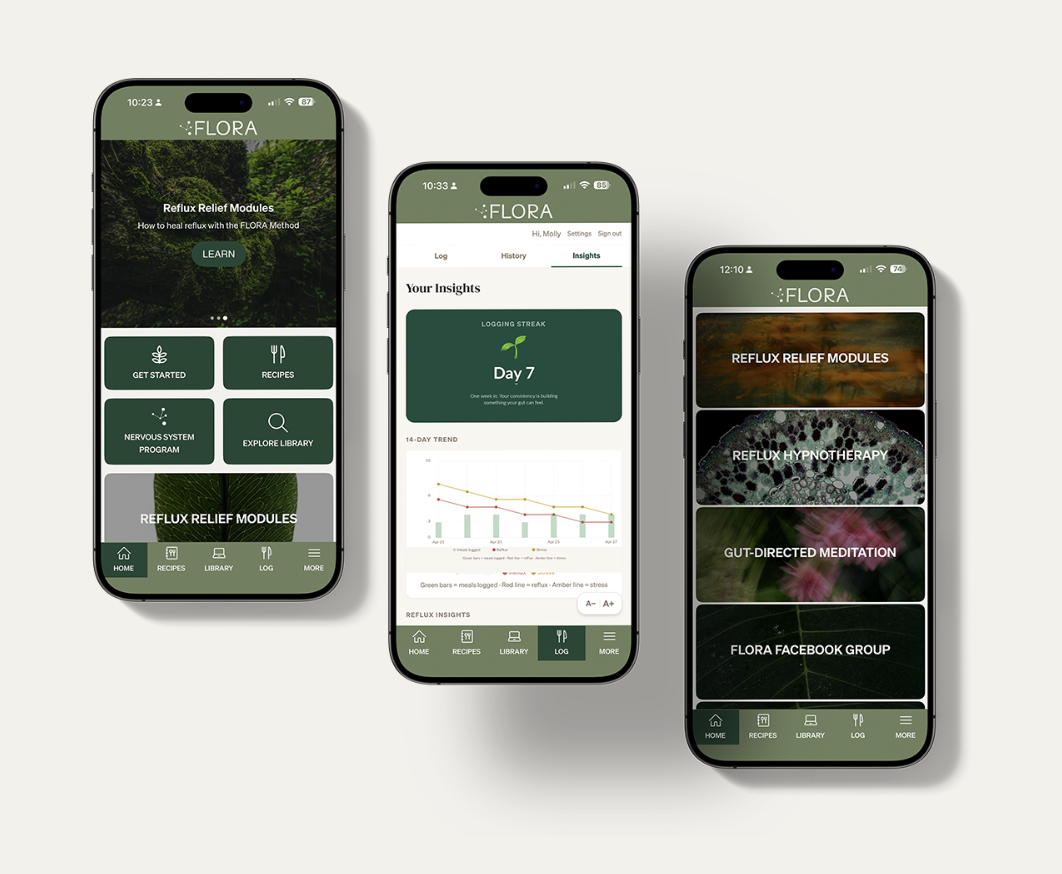
Track your patterns. Knowing when and why symptoms flare turns a guess into data your GI or ENT can act on. The Reflux Clarity Log inside the FLORA App tracks symptoms, food, medication, supplements, and habits like diaphragmatic breathing, and the Insights tab organizes it for your next appointment.
Every one of these is an addition to your healing architecture, and every one works whether or not you stay on your PPI. We support the barrier. We work with your physiology. Small hinges swing big doors.
The Takeaway
If your PPI has not given you the relief you were promised, you are not broken and you are not out of options. The conversation usually needs to include pepsin and non-acid reflux, and the plan needs to address both.
That is what Dr. Johnston and I mapped out in Episode 38. Watch the full conversation above, and if you want the structured path through all of this, the Reflux Relief Masterclass is where we put it together, step by step. For a personalized plan, applications to work 1:1 with our expert team of reflux Dietitians are open at mollypelletier.com/acid-reflux-specialist.
You deserve support that actually explains why your body is doing what it's doing. This is the work we do together.
With love, Molly Pelletier, MS, RD