Short answer: Medication-related GI symptoms often ease after stopping, but no study has tracked reflux specifically after people come off a GLP-1. If weight comes back, reflux risk can come back with it. That's why the habits you build while you're on the medication matter more than the prescription itself.
In this post
Thinking about stopping? Start with your prescriber
Do GI side effects fade when you stop?
What happens to weight after stopping
Why weight changes matter for reflux
A plan for the transition
The takeaway
If your reflux started or got worse on Ozempic or Wegovy, it makes sense to wonder whether stopping would make it go away. That's a fair question, and it's worth working through before you and your prescriber make any changes.
The honest answer is that two things pull in opposite directions. Side effects from the medication may ease. At the same time, if weight comes back, reflux risk can come back too. What carries over either way is how you eat, breathe and live day to day. This post walks through both sides so you can have a clearer conversation with your prescriber.
Thinking about stopping? Start with your prescriber
Whether to stop, when, and how are medical decisions, and they belong to you and your prescriber together. I'm a dietitian, so I won't tell you whether to stop or how to do it. What I can do is help you understand what the research shows about reflux on the other side, and how to prepare.
If you haven't read it yet, my full GLP-1 and reflux guide covers why these medications can trigger reflux in the first place.
Do GI side effects fade when you stop?
The best clue comes from a trial called STEP 4. Everyone took semaglutide 2.4 mg (the Wegovy dose) for 20 weeks. Then some people kept taking it and some were switched to placebo.
After week 20, new GI side effects showed up in 41.9% of the people who stayed on semaglutide, compared with 26.1% of those switched to placebo. So people who came off the medication had fewer new GI side effects.
That's encouraging, and it comes with a gap. STEP 4 reported GI side effects as a group. It did not report reflux on its own.
The other trial that followed people after stopping, the STEP 1 extension, didn't collect side-effect data at all. So here's the plain truth: no study has tracked reflux specifically after people stop a GLP-1.
What we can say is that if your reflux is driven by the medication slowing your stomach emptying, it's reasonable to expect that part to ease once the medication is out of your system. For the research on reflux while you're taking semaglutide, see my post on Ozempic and acid reflux.
What happens to weight after stopping
The STEP 1 extension followed 327 people after they stopped semaglutide 2.4 mg. While on the medication, they lost 17.3% of their body weight. In the year after stopping, they regained 11.6 percentage points, for a net loss of 5.6%. On average, that's about two-thirds of the weight they'd lost. That's an average across the group, so it can't predict exactly what will happen for you.
If that has happened to you, or you're worried it will, I want you to hear this clearly: weight regain after stopping is common, and it says nothing about your willpower. I bring weight up here only because, for reflux, it's one of the contributors that matters.
Why weight changes matter for reflux
Extra weight around your middle increases the pressure inside your abdomen. That pressure pushes on your stomach and makes it easier for stomach contents to move up past your lower esophageal sphincter (LES), the valve at the top of your stomach.
Two large observational studies show how closely reflux tracks with weight change. Both found links, which means they can't prove that weight change causes reflux to change.
Weight loss and reflux (HUNT study, 2013). This study followed 29,610 adults in Norway who answered health surveys at two points in time. A BMI drop of more than 3.5 units was linked to better odds of losing reflux symptoms:
About twice the odds among people using reflux medication less than weekly or not at all
About four times the odds among people using reflux medication at least weekly
Weight gain and reflux (Nurses' Health Study, 2006). This study looked at 10,545 women at one point in time. Even in women who started at a normal weight, a BMI increase of more than 3.5 units was linked to 2.8 times the odds of frequent reflux symptoms. Keep in mind that the study included only women.
Put together, these two studies suggest that reflux tends to move with weight in both directions. If weight comes back after stopping a GLP-1, reflux risk can come back with it, even as the medication's own side effects fade.
A plan for the transition
The good news is that the habits that make reflux easier on a GLP-1 are the same ones that protect you after. Start building them now, while you're still taking it, and they'll already be in place when your prescription changes.
1. Keep your meal structure. Smaller meals, protein first, moderate fat, and a last meal well before bed. When your appetite comes back, this structure is what keeps portions in a range your stomach and LES can handle. The weeks when your appetite starts to return are the ones to watch most closely. My GLP-1 sample day shows what a full day looks like.
2. Build your Crural Diaphragm Tone. Your crural diaphragm is the part of the diaphragm muscle that wraps around your LES. It works alongside the valve as part of your reflux barrier, and like any muscle, it responds to training. Daily diaphragmatic breathing keeps it trained.
Here's how I teach it to clients:
Sit or lie down comfortably and place your hands on your lower ribs.
Breathe in slowly through your nose and let your rib cage expand 360 degrees: front, sides and back.
Breathe out slowly and let your ribs settle back in.
The full routine is in my post on diaphragmatic breathing for acid reflux.
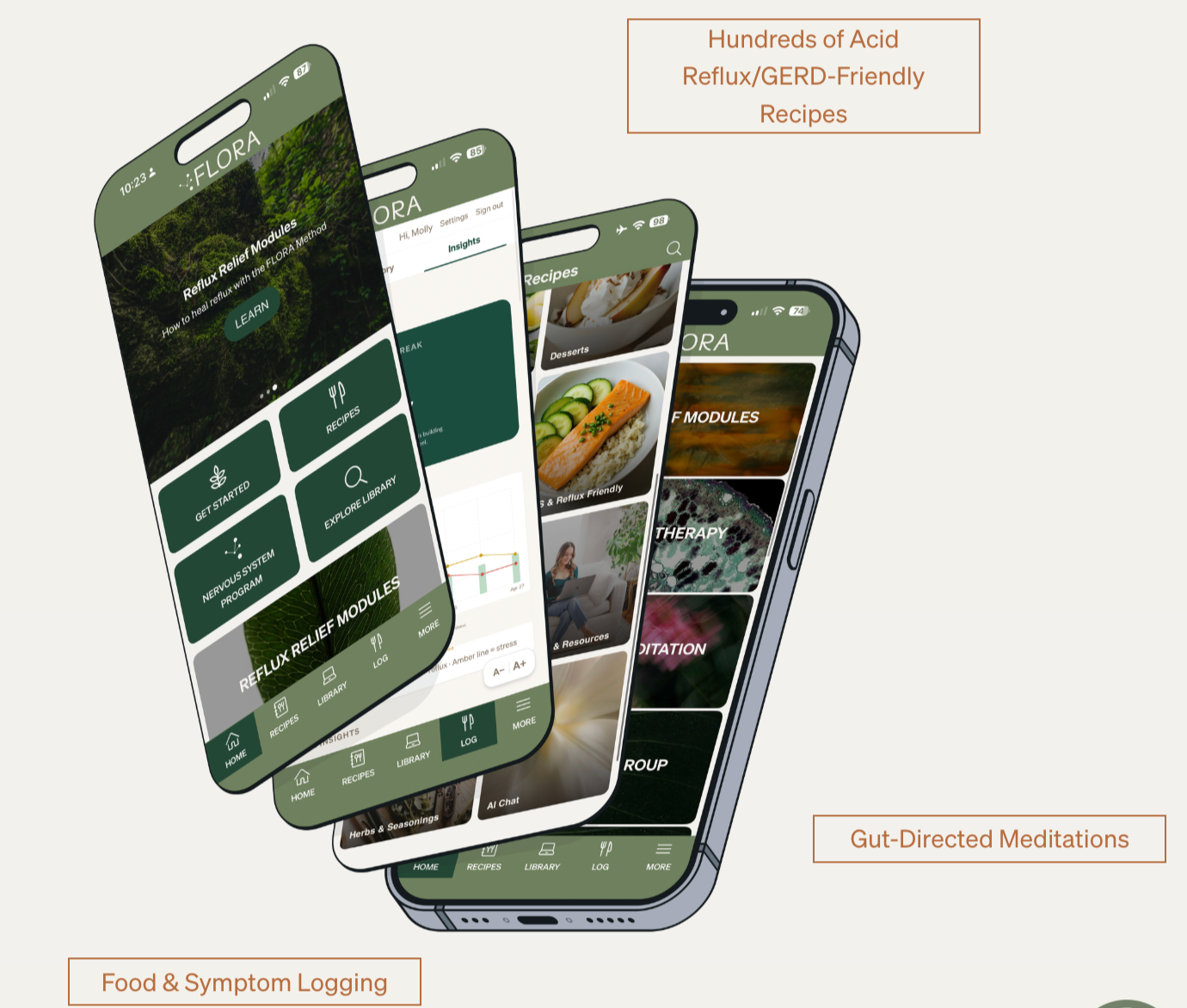
3. Track what changes. The months around a medication change are when your symptoms are most likely to shift, and memory is unreliable. The Reflux Clarity Log in the FLORA App tracks your symptoms, food, medication, supplements and habits in one place. Its Insights tab gives you and your prescriber a clear picture of what changed, and when, at your next appointment.
4. Keep your prescriber in the loop. If reflux returns or gets worse during the transition, tell them. They may want to look at other options, and that conversation goes better with your log in hand.
The takeaway
Stopping a GLP-1 may ease the medication's own side effects, but no study has tracked reflux specifically after people stop, and weight regain can bring reflux risk back. What carries over is your routine. Keep your meal structure, train your crural diaphragm every day, and track your symptoms so you and your prescriber can see what's changing.
Coming off a GLP-1 is a transition, and it goes better with a plan. Our reflux dietitians help clients keep their reflux progress through medication changes. Apply to work 1:1 at https://www.mollypelletier.com/acid-reflux-specialist. To track how your symptoms shift week to week, the Reflux Clarity Log in the FLORA App organizes it for your next appointment: start your 7-day risk-free trial at https://www.mollypelletier.com/flora.
With love,
Molly Pelletier, MS, RD

Verified Citations
Wharton S, Calanna S, Davies M, et al. Gastrointestinal tolerability of once-weekly semaglutide 2.4 mg in adults with overweight or obesity, and the relationship between gastrointestinal adverse events and weight loss. Diabetes Obes Metab. 2022. STEP 4 detail: after the 20-week run-in, GI adverse events with onset in the randomized period in 41.9% continuing semaglutide vs 26.1% switched to placebo. PMID 34514682. https://doi.org/10.1111/dom.14551
Wilding JPH, Batterham RL, Davies M, et al. Weight regain and cardiometabolic effects after withdrawal of semaglutide: The STEP 1 trial extension. Diabetes Obes Metab. 2022. Off-treatment extension, n=327: 17.3% lost, 11.6 percentage points regained, net 5.6%. No systematic collection of adverse events in the extension. PMID 35441470. https://doi.org/10.1111/dom.14725
Ness-Jensen E, Lindam A, Lagergren J, Hveem K. Weight loss and reduction in gastroesophageal reflux. A prospective population-based cohort study: the HUNT study. Am J Gastroenterol. 2013. Prospective cohort, n=29,610. BMI decrease >3.5: OR 1.98 (1.45 to 2.72) with no or less than weekly reflux medication; OR 3.95 (2.03 to 7.65) with at least weekly medication. PMID 23358462. https://doi.org/10.1038/ajg.2012.466
Jacobson BC, Somers SC, Fuchs CS, et al. Body-mass index and symptoms of gastroesophageal reflux in women. N Engl J Med. 2006. Cross-sectional, Nurses' Health Study, 10,545 women. Normal baseline BMI, BMI increase >3.5: OR 2.80 (1.63 to 4.82) for frequent reflux symptoms. PMID 16738270. https://doi.org/10.1056/NEJMoa054391