Gut Microbiome and Acid Reflux: What a 134,000-Person Study Found
Quick answer: A 2026 UK Biobank analysis followed 133,915 people for a median of 13.6 years and found that those eating in the most microbiome-supportive pattern had roughly a 19% lower hazard of developing GERD than those eating in the least. The proposed mechanism runs through short-chain fatty acids, compounds your gut microbes make when they ferment fiber, which support the gut lining and influence motility. One important limit: the study scored diet. It never measured anyone's actual microbiome.
If you have been treating reflux as a problem that lives entirely between your stomach and your throat, this study is worth your attention. Your esophagus, your lower esophageal sphincter, and your stomach are in constant conversation with the rest of your digestive tract, including the trillions of microbes living further down.
That conversation appears to matter more than we used to think.
What the Study Actually Found
Researchers analyzed 133,915 UK Biobank participants who were free of GERD at baseline. Each person's diet was scored using the Dietary Index for Gut Microbiota, a 0 to 14 scale built from foods considered favorable or unfavorable to gut microbes. Over a median follow-up of 13.6 years, 12,271 people developed medically recorded GERD.
Every one-point increase in the diet score was associated with about a 4% lower hazard of GERD. Comparing the highest-scoring group to the lowest, the hazard was 19% lower (HR 0.812, 95% CI 0.774 to 0.851). The researchers also layered in plasma proteomics, measuring thousands of blood proteins, and identified 13 proteins that tracked with both the diet score and GERD risk (Huang et al., 2026, Frontiers in Nutrition 13:1880631, PMID 42483640, DOI).
Now the honest part, because I always give you the real version.
This is an observational cohort. It shows association, not causation. Body mass index accounted for about 21% of the effect and biological aging for about 8%, which means a meaningful share of the benefit may run through weight and aging rather than through microbes directly. The proteomic findings are described by the authors themselves as hypothesis-generating.
And the biggest limitation is the one the authors state plainly: the gut microbiome was never measured. The diet-to-microbiome link is inferred, not observed. We are looking at a proxy.
I am telling you this because a 19% number gets passed around social media stripped of every caveat, and you deserve the version with the caveats attached.
The Mechanism: Short-Chain Fatty Acids
When your gut microbes ferment fiber from the food you eat, they produce short-chain fatty acids, mainly butyrate, propionate, and acetate. Two of their effects are most relevant to reflux.
Barrier support. Butyrate is the primary energy source for the cells lining your colon. It supports mucosal integrity by increasing mucus production and strengthening tight junctions between cells (Hajjar et al., 2021, American Journal of Physiology: Gastrointestinal and Liver Physiology 320(4):G601-G608, PMID 33404375, DOI).
A necessary caveat: that barrier evidence is colonic. Extending it upward to the esophageal lining is a reasonable inference, not a demonstrated fact. I would rather say that clearly than let you believe the research is stronger than it is.
Motility. Delayed gastric emptying is recognized as one of the functional contributors that can worsen GERD, alongside sphincter incompetence, hiatal hernia, and impaired esophageal motility (Fuchs and Meining, 2021, Chirurgia 116(5):515-523, PMID 34749847, DOI). Food sitting in the stomach longer means more upward pressure on the lower esophageal sphincter, the muscle whose job is keeping stomach contents where they belong.
The most direct clinical evidence we have on the fiber side comes from a study of 505 patients with confirmed laryngopharyngeal reflux over 16 weeks. Adding psyllium husk to PPI therapy produced an 82% symptom resolution rate, compared with 75% for PPI plus a prokinetic and 65% for PPI alone. Time to meaningful improvement was shortest in the psyllium group at 6.5 weeks (Rana et al., 2025, Indian Journal of Otolaryngology and Head and Neck Surgery 77(4):1745-1752, PMID 40226240, DOI).
This is why I keep steering the conversation toward what to add rather than what to take away. Restriction alone does not rebuild the mechanisms that are failing. It does not feed the microbes that make butyrate. It does not restore motility. It does not support the barrier.
What This Looks Like on Your Plate
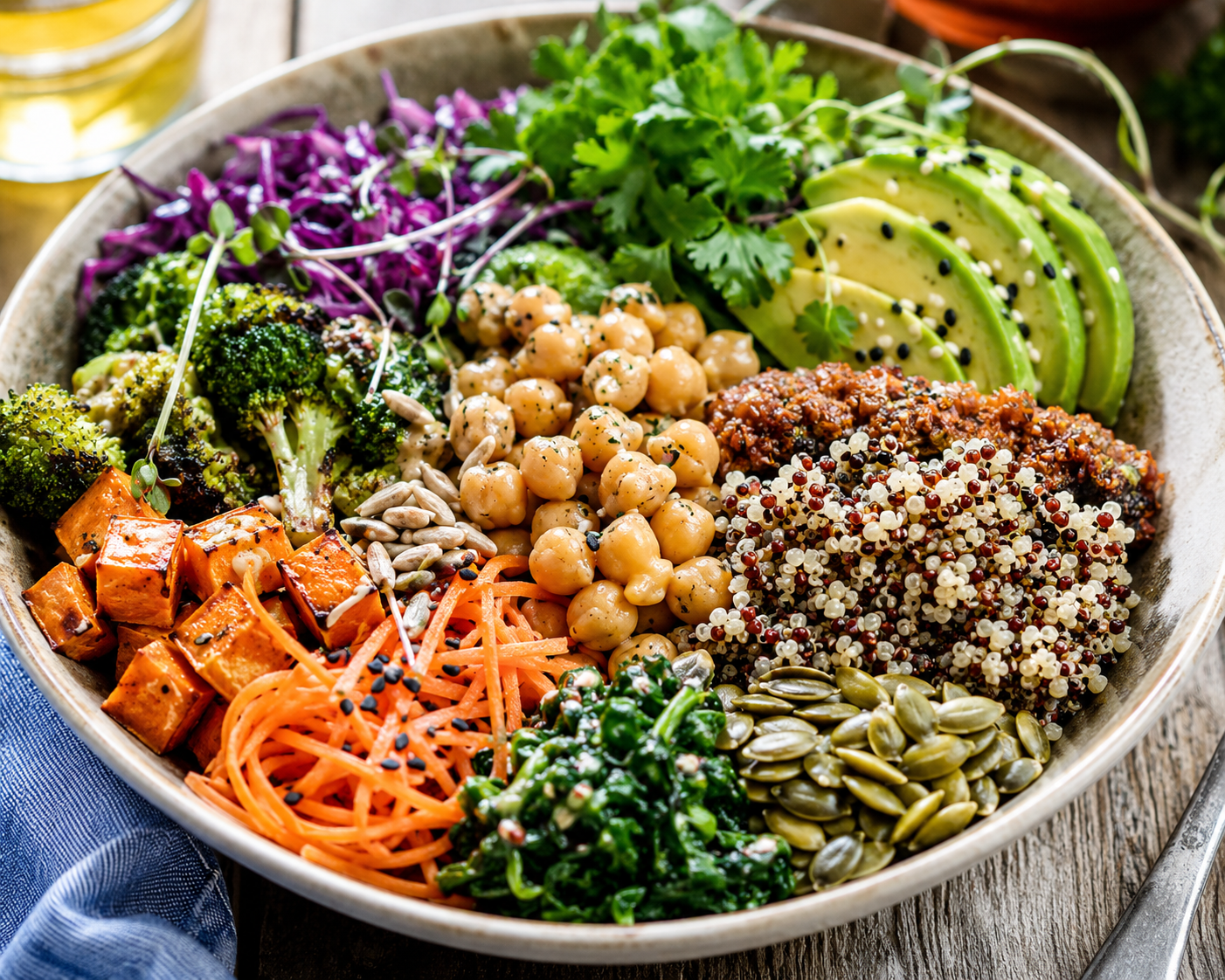
Microbiome diversity is built through variety, and specifically variety in plants.
The number most people have heard is 30 different plant foods per week. It comes from the American Gut Project, a citizen-science cohort of more than 10,000 participants that examined the microbiome alongside the diversity of plants people actually ate. People eating more than 30 distinct plant types per week showed greater microbial diversity than those eating fewer than 10 (McDonald et al., 2018, mSystems 3(3):e00031-18, PMID 29795809, DOI).
Worth knowing: that cohort was self-selected and diet was self-reported, so 30 is a useful target rather than a validated clinical threshold. It is a direction, not a prescription.
Plants count broadly. Vegetables, fruits, legumes, whole grains, nuts, seeds, herbs, and spices all go on the list. A tablespoon of oregano counts. So does the handful of pumpkin seeds on your yogurt.
For reflux clients specifically, I frame this as a strategic addition and we build in slowly. A handful of pumpkin seeds here. White beans in a soup there. A side of cooked fennel, which happens to be gentle on the esophagus. If you have been eating a narrow list of safe foods for a long time, going from 8 plants to 30 in a week will not feel good, and it is not the goal. We add one or two at a time and give your system room to adjust.
Perfection is not the target. Consistency is, because microbiome shifts happen gradually and the healing architecture we are building is meant to last. Small hinges swing big doors.
The Gap This Study Leaves
Read that study closely and you land where I landed. It tells us diet shapes the microbiome, and then it never looks at anybody's gut.
That is the same wall I hit with clients constantly. You can eat 30 plants a week, keep the 3-hour buffer before bed, do your breathing after meals, and still be guessing at what is actually happening in there. Population averages point you in a direction. They cannot tell you whether you have a yeast overgrowth, an opportunistic bacterial pattern, or H. pylori quietly driving gastritis that everyone has been calling reflux.
So I built a way to stop guessing.
The Microbiome Map is built around a GI-MAP, a detailed stool test that reads your beneficial and opportunistic bacteria, yeast and fungal overgrowth, parasites, H. pylori, markers of inflammation in the gut lining, and how well you are actually digesting and absorbing your food.
A test is only as good as what somebody does with it, so the program is the whole arc:
The GI-MAP stool test ($463 lab value), shipped to your door
Full clinical interpretation by a registered dietitian who reads every marker, not a software summary
A 60-minute roadmap session to walk through your results in plain English
A written, personalized protocol phased over about 12 weeks: what to eat, what to take, what to change, and in what order
30 days of messaging support while you get started
A 30-minute follow-up to adjust what is not working
It is application only, and I read every application myself. A GI-MAP is powerful when it is the right tool and a waste of money when it is not. If it is not your best next step, I will tell you that, and tell you what I would do instead, before you spend a dollar.
Apply here. It takes about five minutes and you will hear back within three business days either way. (Due to lab regulations, this program is not available to residents of New York State.)
Not ready for that? Your free move this week: count your plants. Aim for 30 different ones by Sunday and notice how much variety sneaks in once you are actually paying attention.
Frequently Asked Questions
Can gut bacteria cause acid reflux?
The evidence supports an association, not a proven cause. In a cohort of 133,915 people followed for a median 13.6 years, the most microbiome-supportive eating pattern was linked to a 19% lower hazard of GERD (Huang et al., 2026, PMID 42483640). Because the study scored diet rather than measuring microbes, the microbiome link is inferred. Reflux has multiple root contributors, and gut ecology appears to be one of them.
What are short-chain fatty acids and how do they affect reflux?
They are compounds your gut microbes produce when they ferment fiber, mainly butyrate, propionate, and acetate. Butyrate fuels the cells lining the colon and supports mucus production and tight junctions (Hajjar et al., 2021, PMID 33404375). The proposed reflux relevance runs through barrier integrity and motility, though the barrier research is strongest in the colon rather than the esophagus.
Do I really need 30 plants a week?
Thirty is a target drawn from the American Gut Project, where people eating more than 30 plant types per week showed greater microbial diversity than those eating fewer than 10 (McDonald et al., 2018, PMID 29795809). It is a useful direction rather than a clinical requirement. If you are currently at 8, moving to 12 is progress worth having.
Will more fiber make my reflux worse?
It depends on the form, the amount, and your current healing phase, which is why the increase should be gradual. In 505 patients with laryngopharyngeal reflux, adding psyllium husk to PPI therapy improved symptom resolution to 82% versus 65% on PPI alone (Rana et al., 2025, PMID 40226240). Soluble, gentle forms are usually where we start.
Can a stool test tell me why I have reflux?
It can tell you what is present in your gut that a diet questionnaire cannot: bacterial patterns, yeast, parasites, H. pylori, inflammation markers, and digestive function. That is information, not a diagnosis of reflux itself. It works best interpreted by a clinician alongside your full symptom picture and your physician's workup.
About Molly Pelletier, MS, RD
Molly Pelletier is a registered dietitian known as The Reflux Dietitian and the founder of FLORA Nutrition. After healing her own reflux, she built her practice around the mechanisms behind GERD and LPR so people can understand what is actually happening in their bodies. Meet Molly.
If you have been doing the work and still feel like you are missing a piece, a map might be it.
you are loved.