Acid Reflux & Bile Reflux After Gallbladder Removal: What the Research Actually Shows
Quick answer: Something real does change. After gallbladder removal, bile reaches the stomach more often, and studies that followed the same people for years found that change deepening rather than fading. What the evidence does not support is the catastrophe version. Biliary pain resolves in 66 to 100% of people. Digestive symptoms split three ways: most improve, some persist, and about 1 in 10 people picks up a new bowel symptom. The most common new problem is diarrhea, not heartburn, and it has a real treatment that almost nobody mentions. What you are being sold online for this has never been tested.
If you had your gallbladder out and then started searching your symptoms at 2am, I want to say something before we go further. The fear you picked up along the way was not your fault. There is a lot of content built to make you feel like you permanently broke something, and that content moves faster than the research does.
I also want to be honest with you in the other direction, because I think you can handle it and because you have probably already been handled. Some of what you read is true. My goal here is not to talk you out of your symptoms. It is to tell you which parts are real, how big they actually are, and what to do about them.

What Actually Changes When Your Gallbladder Comes Out
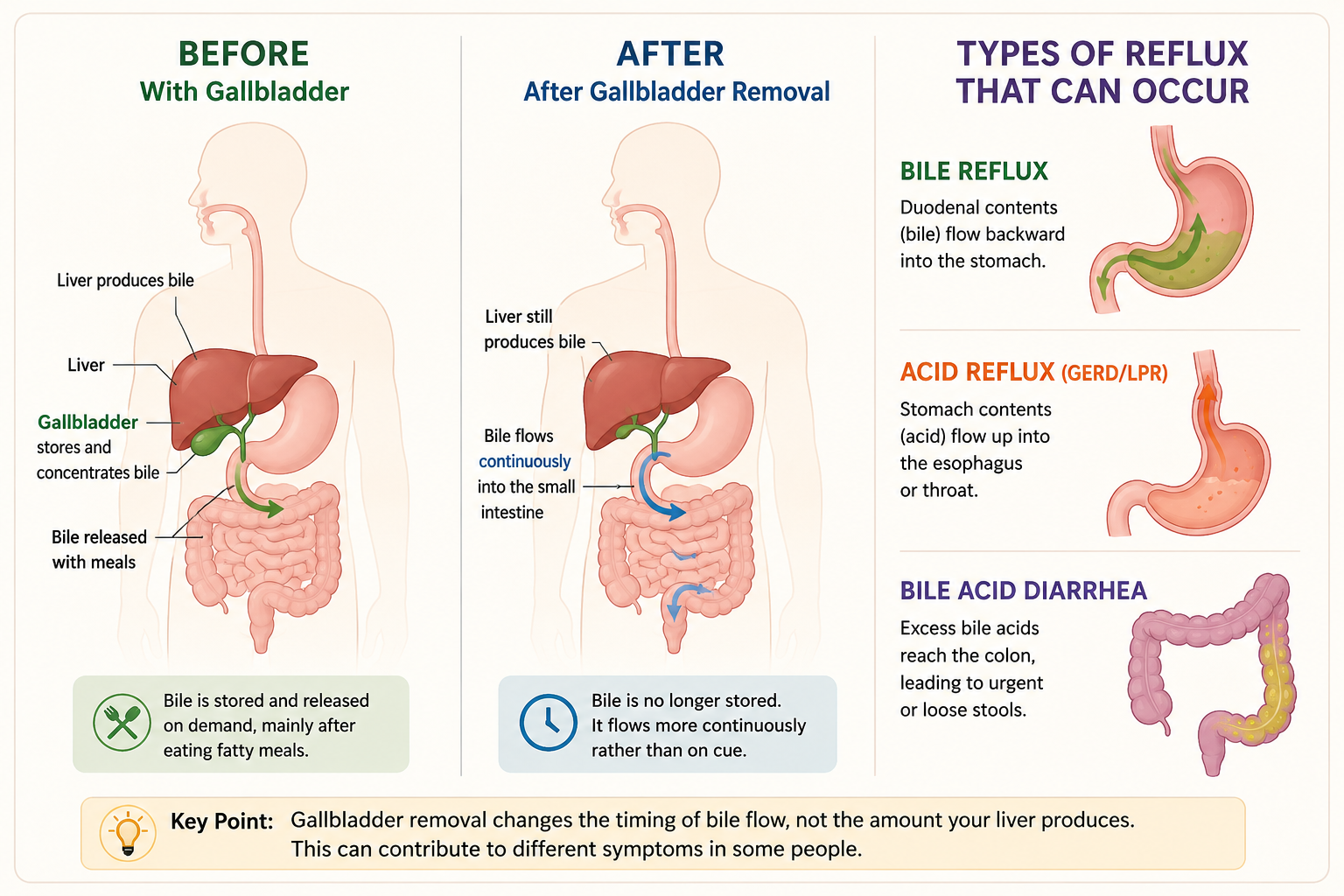
Your gallbladder is a storage and timing organ. It concentrates bile while you are not eating and contracts when nutrients, mainly fat and protein, reach your small intestine. It does not make bile. Your liver does that, and your liver keeps doing it after surgery.
What changes is the timing. Without a reservoir, bile arrives more continuously instead of on cue.
This is the piece of the popular story that is genuinely correct, and it dates back to 1975. Researchers tracked an indirect breath-test marker of bile acid recycling while removing dietary protein and fat. In healthy subjects and in gallstone patients, that marker fell by roughly half, meaning meal signals were driving a large share of the cycling. In patients who had already had their gallbladder removed, the marker did not respond to diet at all (Hepner, 1975, Gastroenterology 68(6):1574-81, PMID 1132637). Worth noting that the study's own headline conclusion is the reassuring half: meaningful bile acid circulation continues even without gallbladder contraction. The timing decouples. The system keeps working.
Does Gallbladder Removal Cause Acid Reflux?
Three separate findings have to sit side by side, and most articles give you only the one that suits them.
Bile really does reach the stomach more often, and it does not settle down
In a study that measured the same 10 patients before surgery, at 6 months, and again about 4 years later, fasting bile acid reflux into the stomach rose from 0.295 to 12.045 to 19.9 µmol per hour, a progressive increase (Friedman test, p=0.0022). Antral atrophic gastritis went from 10% of patients before surgery to 50% at four years (Lorusso et al., 1992, Gastroenterologie Clinique et Biologique 16(4):328-33, PMID 1397852). Ten people is a very small study. The direction is hard to argue with, because each patient served as their own comparison.
A larger endoscopic study found visible bile pooling in the stomach in 34.6% of controls (9 of 26) and 32% of patients before their cholecystectomy (8 of 25), rising to 60% in the same patients at one year (15 of 25, p=0.047), and 79.3% in a separate long-term group operated 5 to 20 years earlier (23 of 29, p=0.001) (Shah Gilani et al., 2017, Journal of the American College of Surgeons 224(3):319-326, PMID 27993699, DOI). The one-year comparison follows the same people. The long-term group is a different cohort measured once, so read it as a snapshot rather than a trajectory.
So the mechanism is real, and if anything it grows. Hold onto that, because it matters for the next part.
The symptom studies mostly come back neutral, and that is weaker evidence than it sounds
The most-cited study here is a prospective controlled observational study comparing 125 elective cholecystectomy patients against 196 inguinal hernia repair patients, using validated reflux questionnaires before and after surgery. Reflux symptom scores changed by -0.34 in the gallbladder group and -0.14 in the surgical controls, which is no meaningful difference (p=0.27). Reflux got very slightly better in both (Lin et al., 2010, Annals of Surgery 251(1):40-5, PMID 19858706, DOI).
I want to be straight about that study's limits, because they matter and most articles quoting it do not mention them. Follow-up was 4 to 12 weeks. It was observational, not randomized, and the two groups were not alike: the hernia controls were mostly men and were older. A three-month questionnaire cannot tell you what happens at year five, and the mechanism above is measured in years.
Two other objective studies agree with it in the short term. Combined impedance and pH monitoring in 63 patients before and after laparoscopic cholecystectomy found no significant change in LES characteristics, acid reflux, or non-acid reflux (Gupta et al., 2014, Tropical Gastroenterology 35(4):222-6, PMID 26349166). And in a case-control study of 790 GERD patients versus 407 controls in a VA population, all endoscoped and ultrasounded, prior cholecystectomy carried an odds ratio of 0.90 (95% CI 0.64 to 1.28), meaning no association. The variable that actually predicted GERD was hiatal hernia, at an odds ratio of 3.15 (Avidan et al., 2001, American Journal of Gastroenterology 96(10):2858-62, PMID 11693317).
Now the study that reconciles the two halves, and the one I would want you to know about. Researchers measured actual bile exposure in the esophagus using a bilirubin monitor in 132 patients with typical GERD symptoms, comparing those with and without a prior cholecystectomy. Symptoms did not differ between the groups. Acid reflux did not differ. Barrett's frequency did not differ. But pathological bile reflux was significantly more common in the cholecystectomy group (76% versus 55%, p<0.01) and more severe (Kunsch et al., 2009, Zeitschrift fur Gastroenterologie 47(8):744-8, PMID 19662586).
Same symptoms. Different exposure. That is exactly the situation where a symptom questionnaire returns "no difference" while something is genuinely going on.
And a lot of these symptoms were already there
In the Lin study, gallstone patients had significantly higher reflux symptom scores than controls before anyone operated on them. In the PERFECT study, a prospective multicenter observational study of 401 patients with gallstones and abdominal pain, 34.9% already met Rome IV criteria for functional dyspepsia or IBS at their pre-surgical visit. Among those who went on to have surgery, being pain-free at six months split along that line: 40.7% of those with a pre-existing functional disorder versus 64.4% of those without (de Jong et al., 2022, Annals of Surgery 275(6):e766-e772, PMID 32889877). Biliary colic itself resolved either way.
Surgery is a vivid, dateable event. Slow-burning dyspepsia is not. When symptoms surface afterward, the human brain files them under the operation, and that filing error is baked into a great deal of what you read.
So what is the honest verdict
Population and genetic data do find a link, and it is small. Mendelian randomization studies, which use genetic variants to get around the confounding problem, put cholecystectomy and GERD at an odds ratio of 1.04 (95% CI 1.02 to 1.06) and Barrett's esophagus at 1.13 (1.06 to 1.19), with the association surviving adjustment for smoking, alcohol and BMI. The same paper found no increased risk of esophageal cancer (Huang et al., 2024, Frontiers in Medicine 11:1420462, PMID 39091288, DOI). Two other genetic analyses published in the same period report much larger odds ratios, around 2.2 and 2.6, and that 60-fold spread between estimates for the same question is a reason to hold all of them loosely.
Putting it together: bile behavior changes permanently, esophageal bile exposure is measurably higher, the effect on how people actually feel is small and inconsistent, and a meaningful share of the symptoms blamed on the surgery predated it. "Gallbladder removal causes GERD" overstates it. "Gallbladder removal has nothing to do with your symptoms" understates it. The truth is a modest, real, mostly-bile effect sitting on top of a population that already refluxed more than average.
Three Different Things Get Called "Reflux After Gallbladder Removal"
Most of the confusion here comes from three separate conditions wearing one name. Sorting yours is the most useful thing you can do this week.
| Bile reflux gastritis | Acid reflux (GERD or LPR) | Bile acid diarrhea | |
|---|---|---|---|
| What moves where | Duodenal contents move backward into the stomach | Stomach contents move up past the LES into the esophagus or throat | Excess bile acids reach the colon |
| What it feels like | Upper belly burning, gnawing, nausea, sometimes bitter taste | Chest burning, regurgitation, throat clearing, lump sensation, hoarseness, cough | Urgent, loose, watery stools, often within an hour of eating |
| Do PPIs help | Not directly. PPIs reduce acid, and bile is not acid | Usually yes, for the acid component | No |
| First move | GI evaluation, meal size and timing strategy | Barrier and LES support, positional and timing strategy | Ask your doctor about bile acid testing or a supervised sequestrant trial |
Look at the third column, because it is where the strongest evidence in this entire topic lives and it is the one the internet skips.
In a post hoc analysis of two prospective trials with 820 patients followed to six months, cholecystectomy resolved biliary colic in 94.8%. But new symptoms that had not been there before surgery showed up in roughly 1 in 10: frequent bowel movements 9.6%, bowel urgency 8.5%, new-onset diarrhea 8.4% (Thunnissen et al., 2023, Surgery 174(4):781-786, PMID 37541808, DOI). A review of prospective studies puts new diarrhea at 14 to 17% (Shabanzadeh, 2023, Journal of Clinical Medicine 12(5):1897, PMID 36902684, DOI).
And there is a real treatment. In a meta-analysis of 7 randomized controlled trials with 311 patients with bile acid diarrhea, bile acid binding therapy produced cessation of diarrhea at a relative risk of 3.27 (95% CI 2.08 to 5.15) and normalized stool consistency at a relative risk of 2.69 (95% CI 1.56 to 4.65). Abdominal cramping was more common on treatment, with a wide confidence interval (Soares et al., 2025, Journal of Clinical Pharmacology 65(4):478-485, PMID 39428959, DOI). Two honest caveats: about a quarter of the treated patients in that pool received chenodeoxycholate, which is a bile acid rather than a binder, and the population was bile acid diarrhea generally, not specifically post-surgical.
Still, if your main problem is urgent loose stools after eating, this is a prescription conversation that may be one appointment away. That is the single most useful sentence in this article.
Where the Internet Gets This Wrong
Some of the viral content is directionally right about the physiology. The bile timing change is real, and I said so above. Where it goes off the rails is what comes next.
The claim that reflux is caused by low stomach acid. This circulates widely, including in Dr. Eric Berg's material, where the stated mechanism is that weak or insufficiently acidic stomach contents fail to signal the lower esophageal sphincter to stay closed. The LES works differently. Resting tone comes from the muscle's own intrinsic activity, vagal and enteric nerve input, and the crural diaphragm wrapped around the esophagus, with hormones like gastrin playing a modulatory role. Acid is not the closing signal. Where researchers have looked, reducing gastric acidity is associated with LES pressure staying the same or going slightly up, which is the opposite of the claim.
This matters practically. If you follow that reasoning to apple cider vinegar or betaine HCl while your esophagus or throat is already irritated, you are adding acid to inflamed tissue.
The ox bile funnel. Search "gallbladder removal" and within two clicks you will be offered ox bile, purified bile salts, or TUDCA. Here is the entire human evidence base. One controlled study from 1993, in Italian, gave 203 cholecystectomy patients either the bile salt TUDCA or no treatment. It was not randomized and had no placebo group. Symptoms improved faster in the treated group at one month, and there was no difference at two months or three months (Croce et al., 1993, Annali Italiani di Chirurgia 64(5):533-7, PMID 8010582). For ox bile specifically, the thing actually being sold to you, there is no controlled trial in cholecystectomy patients at any level of quality.
There is also a mechanism concern. The leading driver of post-surgical diarrhea is too much bile acid reaching the colon, which means adding more bile acids can push some people the wrong way.
The one randomized bile acid therapy with decent data comes from a different operation entirely. In a secondary analysis of the PEGASUS-D trial, 465 patients analyzed after distal gastrectomy for gastric cancer, ursodeoxycholic acid at 300 mg reduced bile reflux (odds ratio 0.44, p=0.0076) and gastritis (0.50, p=0.0368) at twelve months, while symptom scores did not differ between groups. The 600 mg arm, double the dose, showed no benefit (Jang et al., 2024, International Journal of Surgery 110(12):7824-7831, PMID 39422533). A result that appears at one dose and vanishes at double it is a result to hold loosely, and the anatomy in gastrectomy patients is surgically rearranged in a way yours is not.
The scary percentages. You will see post-cholecystectomy syndrome described as affecting "up to 47%" of patients. A 2026 systematic review of 9 studies and 2,948 patients put pooled incidence at 3.21% (95% CI 2.27 to 4.55%). Both figures come from real papers, and the spread is a definition problem: some studies used strict criteria, others counted any reported symptom. In fairness to that review, its own authors flag heavy statistical heterogeneity, note that 97 of 116 candidate studies were excluded because full texts were unavailable, and caution that short follow-up windows may underestimate the real number (Zhou et al., 2026, Medicine 105(7):e47687, PMID 41686575). So take 3.21% as a floor rather than a verdict. The point stands: a percentage quoted with no definition attached is how a statistic becomes a fear.
The cancer question, which I am not going to hand off without telling you what is in the literature. A Swedish cohort followed 345,251 people after cholecystectomy for a mean of 15 years and found 126 esophageal adenocarcinomas against an expected count, a standardized incidence ratio of 1.29 (95% CI 1.07 to 1.53), with the association tending to strengthen with longer follow-up. Two features make it hard to wave away: there was no association with squamous cell cancer, and a separate cohort of 192,960 people who had gallstones but never had surgery showed no excess at all, at 0.99 (0.71 to 1.35) (Lagergren and Mattsson, 2011, British Journal of Surgery 98(8):1133-7, PMID 21590760, DOI).
Now the other side, which is substantial. The authors' own conclusion is "the absolute risk is small." A 29% relative increase on a very low baseline is a small absolute shift. The genetic analysis described earlier found increased reflux and increased Barrett's but no increase in esophageal cancer. Nobody recommends routine surveillance endoscopy after gallbladder removal, and I am not suggesting it.
What I am suggesting is narrower. If you have persistent reflux symptoms years after your gallbladder came out, that deserves a gastroenterologist rather than indefinite self-management. Not because you are in danger. Because the ordinary reasons to evaluate long-standing reflux apply to you like anyone else.
How Long Does Reflux After Gallbladder Surgery Last?
This is the most-asked and least-answered question in the topic, so here is the version I would give you in session, including the part that complicates it.
Biliary pain resolves, and reliably. Across prospective studies, resolution runs 66 to 100% (Shabanzadeh, 2023, PMID 36902684).
Digestive symptoms are more mixed. In the 820-patient analysis above, most abdominal symptoms decreased significantly, but 36.5% still reported abdominal pain of some kind at six months, and roughly 1 in 10 had a genuinely new bowel symptom (Thunnissen et al., 2023, PMID 37541808). The same review that reports 66 to 100% biliary pain resolution also finds dyspepsia can develop after surgery, and diarrhea newly appears in 14 to 17%.
And the bile change itself does not fade. I told you earlier that bile reflux measurements climb over years. I am not going to pretend that squares neatly with "give it time." Both things are true at once: most people adapt to a change that is still happening, and a minority do not. Adaptation is about your system accommodating, not about the bile going back to how it was.
In a prospective cohort with matched healthy controls at twelve months, new-onset functional dyspepsia occurred in 14.8% of patients versus 6.9% of controls and new-onset functional diarrhea in 6.6% versus 0.2%. Notably, pre-existing functional GI symptoms were more common in the gallstone group to begin with and improved after surgery, with chronic diarrhea the one exception (Chang et al., 2023, Frontiers in Medicine 10:1248465, PMID 37869171, DOI).
So: most people are better at a year than they were before surgery, a meaningful minority carry something new, and diarrhea is the symptom that does not follow the improving curve.
For practical purposes, treat "persistent" as still meaningfully present past the three to six month mark despite reasonable adjustments to meal size, fat distribution, timing and nervous system state. That is a threshold for getting evaluated, not a biological deadline.
What Actually Helps
"The scary version is overstated" is only half a conversation. Some of you have symptoms right now and deserve a plan.
I am grading these honestly. Some have good evidence, some are mechanistically sound but untested in this specific population, and I will tell you which is which rather than dressing them up.
Mealtime mechanics and how you eat. Without a concentrated bile release, one very large, very high-fat meal has the least available bile to work with at that moment. Distributing fat across the day in moderate amounts, rather than eliminating it, is the strategic move. You need fat to absorb vitamins A, D, E and K well, so cutting to zero creates a new problem while solving nothing. This reasoning is mechanistic. No trial has tested fat redistribution in post-cholecystectomy patients, and I would rather tell you that than imply one exists.
What I teach my clients here is Mealtime Mindfulness. Chew to roughly applesauce consistency. Slow the pace. Single-task the meal. Keep liquid volume at the table moderate. Chewing drives a meaningful share of digestive secretion, and meal volume is one of the modifiable inputs to LES pressure. These are sensible and low-risk, and I want to be clear that they have not been tested against reflux outcomes in trials.
The 3-hour buffer. In a prospective randomized crossover study, 30 patients ate a standardized meal either 6 hours or 2 hours before bed with 48-hour pH monitoring. The late meal produced significantly more supine reflux (p=0.002), concentrated in people with hiatal hernia, higher BMI, esophagitis, and heartburn as the main complaint. Total symptom scores did not differ between the two nights (Piesman et al., 2007, American Journal of Gastroenterology 102(10):2128-34, PMID 17573791). The acid exposure moved. How people felt on those two nights did not, which is worth knowing before you expect an overnight difference. Aim to finish eating about 3 hours before you lie down. Drinks are fine.
Nervous system support, which is not a soft add-on here. In 127 patients assessed one week after laparoscopic cholecystectomy, pre-operative anxiety was associated with 6.38 times the odds of post-cholecystectomy syndrome (95% CI 2.07 to 19.67) and moderate to severe pre-operative dyspepsia with 4.01 times the odds (1.34 to 12.02) (Shrestha et al., 2024, Scientific Reports 14:4903, PMID 38418688, DOI). Those confidence intervals are wide and one week after abdominal surgery is early, so read it as a signal rather than a precise number. Read it anyway, if you have ever been told your symptoms are "just stress" in a dismissive way. This is the opposite of dismissive. It names a modifiable root contributor.
The practice I use with clients is the LES Lock. One to five minutes of diaphragmatic breathing with 360 degree ribcage expansion, immediately after meals, up to five times daily. The mechanism is the crural diaphragm, which wraps the esophagus and acts as an external sphincter alongside the LES. In a randomized controlled study of 19 patients total with non-erosive reflux, the training group's time with esophageal pH below 4 fell from 9.1% to 4.7% after four weeks, with no change in controls. At nine months, the 11 patients who kept practicing had substantially reduced PPI use, and those who stopped lost the effect (Eherer et al., 2012, American Journal of Gastroenterology 107(3):372-8, PMID 22146488). Nineteen people is a small study, it was unblinded, and the nine-month group chose themselves. The American Gastroenterological Association names diaphragmatic breathing, relaxation strategies, hypnotherapy and CBT for patients with functional heartburn or reflux hypersensitivity, delivered by a behavioral therapist (Yadlapati et al., 2022, Clinical Gastroenterology and Hepatology 20(5):984-994, PMID 35123084). That is an endorsement for a specific phenotype, not a blanket one.
Soluble fiber, used strategically. In an uncontrolled 10-day before-and-after study, 30 patients with non-erosive reflux disease and baseline fiber intake under 20 grams a day took psyllium at 5 grams three times daily. Minimal resting LES pressure rose from 5.41 to 11.3 mmHg (p=0.023) and total reflux episodes fell from 67.9 to 42.4 (p<0.001). Heartburn frequency fell from 93.3% of patients to 40% (Morozov et al., 2018, World Journal of Gastroenterology 24(21):2291-2299, PMID 29881238, DOI). Three caveats worth having: there was no placebo group and no control arm, the patients were selected for being fiber-deficient so the effect may be correcting a gap, and acid exposure measures did not change. Reflux episode count fell, acid exposure did not.
In laryngopharyngeal reflux specifically, a randomized but unblinded three-arm study of 505 patients over 16 weeks found symptom resolution of 82% with psyllium added to a PPI versus 65% with PPI alone (Rana et al., 2025, Indian Journal of Otolaryngology and Head Neck Surgery 77(4):1745-1752, PMID 40226240). Single center, no placebo arm. Start low and build slowly with adequate fluid.
Your microbiome. A systematic review of 14 studies found measurable microbiome changes after cholecystectomy, and its actual conclusion is that the changes are significant but inconsistent across studies (Ang et al., 2025, Journal of Gastroenterology and Hepatology 40(3):574-583, PMID 39675817). The best before-and-after design, sampling 39 gallstone patients pre-operatively with post-operative samples in a subset at 3 months, found the composition differences were largely already present in the gallstone population rather than created by the operation (Noh et al., 2023, International Journal of Surgery 109(9):2585-2597, PMID 37288587). For what to do about it, the strongest randomized human data belongs to fermented foods. In a 17-week randomized study of 18 healthy adults per arm, the high-fermented-food arm increased microbiota diversity and decreased inflammatory markers, while the high-fiber arm did not change community diversity and its primary immune outcome was unchanged (Wastyk et al., 2021, Cell 184(16):4137-4153, PMID 34256014). Small, healthy participants, nobody with reflux, and untested in post-cholecystectomy patients.
Alginate therapy. A raft works physically rather than by suppressing acid, so it addresses something a PPI structurally cannot. A meta-analysis of 14 randomized controlled trials with 2,095 patients found alginates increased the odds of symptom resolution versus placebo or antacids at an odds ratio of 4.42 (95% CI 2.45 to 7.97), with substantial heterogeneity between studies. Against PPIs or H2 blockers, alginates came out lower with a non-significant pooled estimate of 0.58 (0.27 to 1.22) (Leiman et al., 2017, Diseases of the Esophagus 30(5):1-9, PMID 28375448). A second meta-analysis did not find a significant pooled effect at all. Promising rather than settled, and best positioned as an add-on.
Sleep position. In a double-blind, randomized, sham-controlled trial, 100 patients wore an electronic device that vibrated when they rolled onto their right side. Both groups were advised to sleep left lateral. Treatment success, defined as at least a 50% reduction in nocturnal reflux score, was 44% with the active device versus 24% with sham (risk difference 20%, 95% CI 1.8 to 38.2, p=0.03) (Schuitenmaker et al., 2022, Clinical Gastroenterology and Hepatology 20(12):2753-2762, PMID 35301135). What was tested was a device that keeps you off your right side, so read it as support for the position rather than proof of it. Pair with 6 to 9 inches of head elevation from the frame or a wedge, not stacked pillows.
Digestive enzymes, honestly graded. Your gallbladder never made enzymes. Your pancreas does, and there is no good evidence that removing the gallbladder causes pancreatic insufficiency. I searched for randomized trials of enzyme supplementation after cholecystectomy across several term combinations and found none. If you have greasy, floating, foul-smelling stools, unintentional weight loss, or signs of fat-soluble vitamin deficiency, the useful step is a fecal elastase test to find out whether true exocrine pancreatic insufficiency is present, because that has a prescription-strength answer. Blind supplementation aims at a step that may not be your problem.

When to Call Your Doctor
Some symptoms after gallbladder surgery are not a nutrition question, and I want you to know the difference.
Contact your physician promptly for jaundice or yellowing, dark urine, pale stools, fever with right upper quadrant pain, worsening rather than improving pain, or abnormal liver enzymes. Retained stones, bile duct strictures and remnant cystic duct stones are real, treatable causes of ongoing pain that no diet will touch.
For reflux specifically, the standard alarm features warrant evaluation: difficulty swallowing, painful swallowing, unintentional weight loss, GI bleeding or anemia, persistent vomiting, or symptoms that do not respond to an appropriate trial of acid suppression (Yadlapati et al., 2022, PMID 35123084).
Asking for a workup is not being difficult. It is being a good historian of your own body.
Where to Start
If you take one thing from this article, make it this. Reflux after gallbladder removal is not a verdict, and you did not break yourself by having a necessary operation.
The most common pattern I see in practice is someone who read the scary version, cut fat to almost nothing, added three supplements that were never studied for this, and is now more restricted, more anxious, and no better. Restriction alone does not rebuild the mechanisms that are struggling. It does not improve bile handling. It does not restore LES tone. It does not calm a nervous system that has been on alert since the surgery date.
So the sequence I would use is boring and effective. Sort which of the three problems you actually have. Fix mechanics before you buy anything. Give it a defined window rather than an open-ended one. And test rather than guess if it does not resolve.
If you want a partner in that, this is exactly what we do together in my 1:1 practice. We start with a Roadmap Session where we map what is actually going on for you, identify your specific root contributors, and build the first phase of a plan you can follow. From there, most clients move into the 3-Month Program, where we work the plan together and adjust as your body responds. The Roadmap fee applies toward the program if you enroll within 14 days.
Apply to work with us. 1:1 counseling is currently available to clients in the United States. If you are outside the US, the Reflux Relief Masterclass covers the same frameworks in a self-guided format.
You do not have to figure this out from search results at 2am.
Frequently Asked Questions
Can gallbladder removal cause acid reflux?
It can contribute, and the effect is smaller than the internet suggests. Bile measurably reaches the stomach and esophagus more often after surgery. Genetic analyses that get around confounding put the increase in GERD risk at an odds ratio of around 1.04 (Huang et al., 2024, PMID 39091288). Symptom studies mostly come back neutral, though one study using objective bile monitoring found the same symptoms with significantly more bile exposure in cholecystectomy patients (Kunsch et al., 2009, PMID 19662586), which suggests symptom questionnaires miss part of the picture.
How long does acid reflux last after gallbladder surgery?
Biliary pain resolves in 66 to 100% of people. Other digestive symptoms are mixed. At six months, most abdominal symptoms have decreased, but 36.5% of patients still report abdominal pain of some kind and roughly 1 in 10 has a new bowel symptom (Thunnissen et al., 2023, PMID 37541808). Bile reflux into the stomach itself does not reverse. Most people adapt to it. If symptoms are still meaningfully present past three to six months despite adjustments, that is the point to investigate rather than wait.
What is the difference between bile reflux and acid reflux?
Acid reflux is stomach contents moving up past the lower esophageal sphincter into the esophagus or throat. Bile reflux is duodenal contents moving backward into the stomach, which tends to produce upper belly burning and nausea rather than chest burning. The practical difference is that PPIs reduce acid and do not reduce bile, which is why acid suppression sometimes helps only partially.
Do I need to take bile salts or ox bile after gallbladder removal?
The evidence is nearly empty. One non-randomized 1993 study of 203 patients using the bile salt TUDCA found faster symptom improvement at one month and no difference at two or three months (Croce et al., 1993, PMID 8010582). For ox bile specifically there is no controlled trial in cholecystectomy patients at any quality level. In people whose main symptom is urgent loose stools, the mechanism points the other way, since excess bile acid reaching the colon is the driver.
Why don't reflux medications work after gallbladder removal?
PPIs reduce acid production. If a meaningful part of your symptom picture is bile rather than acid, acid suppression can only address part of the problem. Incomplete response is a reason to look more carefully at the mechanism, not evidence that you are imagining symptoms.
Can gallbladder removal cause silent reflux or LPR?
Nobody has run the study that would give you a real number. There is a substantial body of work showing bile acids can injure laryngeal tissue, and a substantial body of work showing cholecystectomy increases bile reflux. Almost nobody has connected the two. The closest thing is a small study of 34 post-cholecystectomy GERD patients reporting atypical, non-heartburn presentations in about 45% of them (Sirchak et al., 2023, PMID 37057778), which is far too small to build a decision on. What is true is that the LPR toolkit of barrier support, timing, fiber and nervous system work applies regardless of what started it.
Should I eat a no-fat diet after gallbladder removal?
No. You need fat to absorb vitamins A, D, E and K well, and eliminating it creates a new problem. The strategic approach is distributing moderate amounts of fat across the day instead of concentrating it in one large meal, since bile now arrives continuously rather than in a meal-timed release.
About Molly Pelletier, MS, RD
Molly Pelletier is a registered dietitian known as The Reflux Dietitian and the founder of FLORA Nutrition. After healing her own reflux, she built her practice around the mechanisms behind GERD and LPR so people can understand what is actually happening in their bodies instead of guessing. Meet Molly.