Hiatal Hernia Diet & Natural Support: A Reflux Dietitian's Guide
If you were told you have a hiatal hernia and then handed a photocopied list of foods to avoid, I understand why you left that appointment feeling like nobody explained anything.
Most people walk out knowing two things. Part of their stomach is sitting somewhere it shouldn't be, and they should probably skip tomatoes. That's it. Nobody tells them what the hernia is actually doing to their anti-reflux barrier, why their symptoms are worse after big meals and at night, or which of the strategies floating around online have research behind them and which ones do not.
So let's do this properly. I want you to understand the mechanism first, because once you see what a hiatal hernia changes about your barrier, every recommendation that follows will make sense instead of feeling arbitrary.
One honest note before we start, and I'd rather say it up front than bury it. Food and breathing practices do not close a hiatal hernia. Nothing in this article repairs the anatomy. What these strategies do is change the conditions around the hernia so that it produces fewer symptoms, and that distinction matters. Anyone promising you that a diet will fix the hernia itself is selling you something.

Your Anti-Reflux Barrier Has Two Parts, Not One
Most people picture the lower esophageal sphincter (LES) as a single valve at the bottom of the esophagus. That picture is incomplete, and the missing piece is exactly the piece a hiatal hernia disrupts.
Your anti-reflux barrier is actually two structures stacked on top of each other in the same place. There's the LES itself, a ring of smooth muscle you don't consciously control. And wrapped around the outside of it is the crural diaphragm, the muscular sling of your breathing diaphragm that passes around the esophagus like a second set of hands. Two valves, one location, working together.
The crural diaphragm is the part almost nobody explains to you. Every time you inhale, it contracts and squeezes the esophagus. Every time you cough, strain, bend forward, or lift something heavy, it clamps down harder to counteract the pressure spike coming up from your abdomen. It is your barrier's dynamic reinforcement, and it responds in real time to what your body is doing.
A hiatal hernia separates those two structures. The upper part of your stomach slides up through the opening in the diaphragm, and now your LES is sitting above the crural diaphragm instead of nested inside it. On the manometry studies your GI doctor might run, this shows up as a measurable gap. The current international standard for interpreting these studies, the Chicago Classification version 4.0, defines a hiatal hernia by exactly this separation between the LES and the crural diaphragm (Kahrilas et al., 2021, Neurogastroenterology & Motility, PMID: 33655610, DOI).
Two valves that were designed to work in the same spot are now working in two different spots. That's the whole problem, and it explains almost everything that follows.
The Three Things a Hernia Actually Changes
1. Your barrier loses its reinforcement
With the LES and the crural diaphragm separated, pressure spikes that your barrier used to absorb now get through. This is why symptoms show up when you bend to load the dishwasher, when you lift something awkward, when you cough through a cold, or after a meal large enough to press outward on everything around it. The reinforcement that was supposed to meet that pressure is no longer in position (Zachariah et al., 2020, Gastrointestinal Endoscopy Clinics of North America, PMID: 32146942, DOI).
2. The acid pocket gets trapped in the wrong place
This is the mechanism I most wish people knew about, because it explains the postprandial pattern so cleanly.
After you eat, food buffers most of the acid in your stomach. But a thin, unbuffered layer of acid floats on top of that meal, sitting right at the junction where your stomach meets your esophagus. Researchers call it the acid pocket. In a healthy barrier, that pocket sits below the diaphragm, where the crural sling can keep it contained.
A hiatal hernia relocates it. In a study using radioactive labeling to visualize exactly where the pocket sat in the moments before a reflux event, the pocket was positioned within the hiatus or above the diaphragm before 77% of those events in patients with hernias 3 cm or larger, compared with 22% in healthy volunteers. When the pocket sat above the diaphragm, acidic reflux went up significantly in every group studied (Beaumont et al., 2010, Gut, n=32, PMID: 19651625, DOI).
Read that again, because it reframes the whole problem. The issue is less about how much acid you're making and more about where the acid is sitting when your barrier relaxes. A pocket of unbuffered acid parked above your diaphragm is essentially pre-loaded to reflux.
3. Clearance slows down
Your esophagus is supposed to sweep refluxed material back down quickly. Repeated acid exposure from a hernia pouch can blunt the vigor of those contractions over time, which means material sits in contact with tissue longer, which drives more irritation. Larger hernias are also more associated with difficulty swallowing for this reason (Philpott & Sweis, 2017, Current Gastroenterology Reports, PMID: 28730506, DOI).
So three root contributors, all mechanical, all downstream of one anatomical change. Now here's the good news, and it's real. Two of those three are highly responsive to how you eat and how you breathe.
The Protocol I Use With Hiatal Hernia Clients
Here's what I teach my clients. These are the practices we build together, in this order, and I'll give you the mechanism behind each one so you know why it earns its place.
The LES Lock: train the diaphragm you still have
Your crural diaphragm may be out of position relative to your LES, but it is still a skeletal muscle. Skeletal muscle responds to training. This is the single most mechanistically direct thing you can do for a hiatal hernia, and it's the practice I'd start with.
We have good evidence that diaphragmatic breathing raises pressure at the esophagogastric junction in real time. In a randomized controlled trial at Mayo Clinic, LES pressure during the inspiratory phase of diaphragmatic breathing measured 42.2 mmHg compared with 23.1 mmHg without it, and doing the breathing after a meal cut postprandial reflux events from 2.60 to 0.36 (Halland et al., 2021, American Journal of Gastroenterology, PMID: 33009052, DOI). You are, quite literally, manually reinforcing your barrier while you breathe.
There's also longer-term data. In a randomized trial, GERD patients who trained the crura of the diaphragm with breathing exercises roughly halved the time their esophagus spent exposed to acid, from 9.1% of the day down to 4.7%. Quality of life scores improved, and at nine months the participants who kept the practice going had reduced their PPI use from 98 mg per week to 25 mg (Eherer et al., 2012, American Journal of Gastroenterology, n=19, P<0.05, PMID: 22146488, DOI).
Now the caveat, and I want to be straight with you about it: that second study specifically excluded patients with large hernias. So we are extending a finding from a population without significant hernias to a population with one. The Mayo mechanism data on LES pressure applies regardless, and the practice carries no downside, but I'm not going to tell you the halving of acid exposure was demonstrated in people with your anatomy. It wasn't. It's a small study, and the honest read is that the mechanism is well established and the outcome data in large hernias is still thin.
How to do the LES Lock: 1 to 5 minutes of diaphragmatic breathing with 360-degree ribcage expansion, immediately after meals, up to 5 times daily. Not just belly breathing. You want the lower ribs to expand outward and back as well as forward. Bite-size practices like this tend to be more achievable than one long session, and consistency is the secret sauce.
The 5+1 Method: get your body somewhere safe before the first bite
Before you eat, five slow breaths and one moment of gratitude. That's it. The point is to bring your rest-and-digest system online before food arrives, because digestion works properly when your body feels safe.
This isn't soft framing. A 2025 case-control study found that people with reflux carried significantly higher perceived stress than healthy controls, scoring 21.6 versus 13.9 on the PSS-10, along with higher anxiety and depression scores (Barillari et al., 2025, European Archives of Oto-Rhino-Laryngology, n=74, PMID: 40258993). Your nervous system state affects motility, gastric emptying, and how sensitive your esophagus is to anything that does come up. With a hernia already compromising the mechanics, you want every other variable working for you.

Meal architecture: volume is the lever
Large meals distend the stomach, and a distended stomach pushes outward on a barrier that has less structural support than it used to. Volume is one of the most direct things you control.
What this looks like in practice: smaller portions eaten more often, rather than two or three large meals. Slowing down enough that you notice fullness at around 80% rather than 100%. Sitting upright while you eat and staying upright for a while afterward. Sipping fluids alongside meals instead of drinking large volumes with them, so you're not adding to the distension.
Every one of those is about pressure, not about restriction. Nothing here asks you to remove another food from a list that's probably already too short.
The 3-Hour Buffer and how you sleep
Lying down removes gravity from the equation, which for a hernia means the acid pocket has nothing keeping it below the junction.
Aim to finish eating about 3 hours before you lie down. Beverages in that window are fine. In a systematic review of lifestyle intervention in GERD, late evening meals increased the time spent with acid exposure while lying down compared with earlier meals, and elevating the head of the bed reduced that supine acid exposure from 21% to 15% of the time (Ness-Jensen et al., 2016, Clinical Gastroenterology and Hepatology, PMID: 25956834, DOI).
Two specifics that matter for elevation. Raise the head of the bed itself, 6 to 8 inches, using risers or a wedge that lifts your whole torso. Stacking pillows bends your neck without changing the angle of your esophagus, and it can raise abdominal pressure by folding you at the waist.
Sleep position is worth attention too. A systematic review and meta-analysis found that sleeping in the left lateral position reduced both acid exposure time and the time it took to clear acid compared with sleeping on the right side or on your back (Simadibrata et al., 2023, World Journal of Clinical Cases, PMID: 37969463, DOI). The anatomy is on your side here. Left side down positions the junction above the pool of gastric contents.
Alginate rafts: the most hernia-specific tool we have
Of everything in this article, this is the intervention with the most directly applicable evidence, because the study was done in exactly this population.
An alginate raft is a seaweed-derived polymer that forms a physical raft floating on top of your stomach contents. It doesn't suppress acid. It sits on the acid pocket as a barrier.
Researchers gave an alginate-antacid to patients with symptomatic GERD and large hiatal hernias, labeled it so they could track where it went, and watched what happened. The raft localized directly to the acid pocket. Acid reflux episodes dropped to a median of 3.5 compared with 15 in the group given a plain antacid. Time to the first acid reflux event stretched from 14 minutes to 63 minutes. And the acid pocket ended up positioned below the diaphragm in 71% of the alginate group compared with 21% of the antacid group (Rohof et al., 2013, Clinical Gastroenterology and Hepatology, n=16, PMID: 23669304, DOI).
The raft physically pushed the acid pocket back where it belongs. For a mechanism that a hernia specifically breaks, that's about as targeted as it gets. Broader evidence supports alginates too: a meta-analysis of 14 randomized trials covering 2,095 patients found alginates increased the odds of GERD symptom resolution compared with placebo or antacids, roughly four times the odds (Leiman et al., 2017, Diseases of the Esophagus, OR 4.42, 95% CI 2.45 to 7.97, PMID: 28375448).
Reflux Raft is the alginate raft I recommend to clients. I don't make it, and it isn't my product. It's a third-party formulation I point people toward because the mechanism is so well matched to this problem, particularly after meals and before bed.
Soothing support while tissue recovers
When refluxed material has been reaching tissue repeatedly, that tissue is irritated, and irritated tissue is more reactive to everything. Mucilaginous herbs like slippery elm coat and soothe on the way down, which is why they show up in almost every historical remedy for upper GI discomfort.
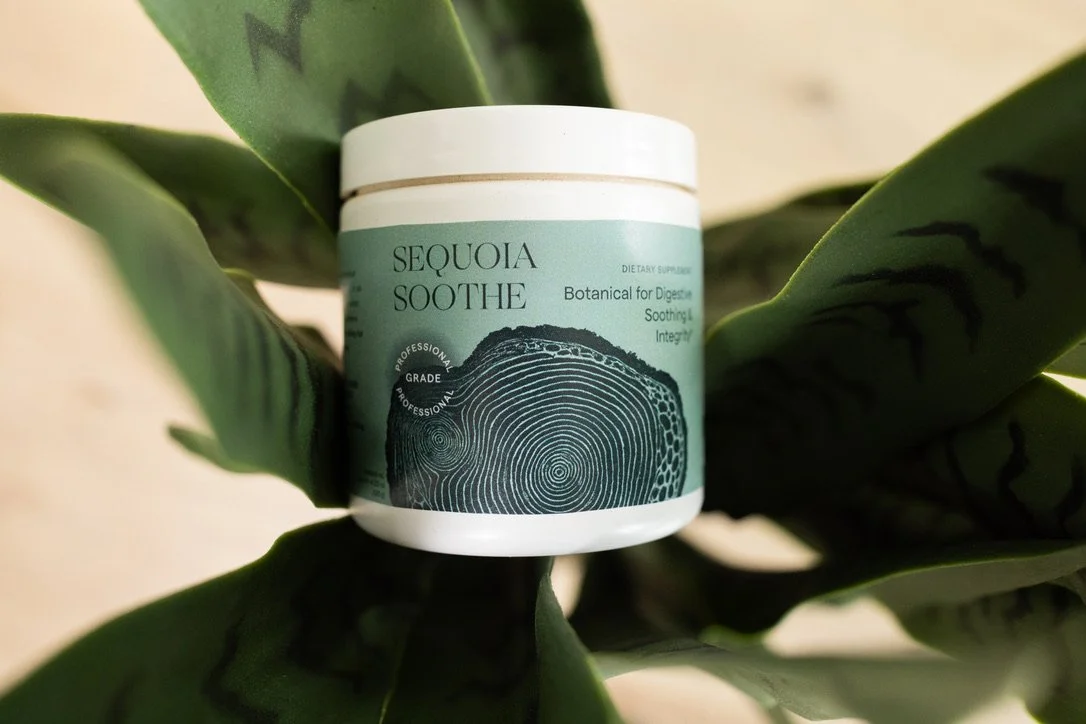
This is the thinking behind Sequoia Soothe, the powder I formulated with the ingredients I reach for in clinical practice: slippery elm at 1,000 mg and DGL at 300 mg to soothe and support mucosal tissue, L-glutamine at 2,500 mg to support gut lining integrity, and zinc carnosine at 7.5 mg to support gastric and esophageal tissue integrity. It's smooth and easy to drink, without the sharp flavors that bother an already sore throat. It's there to soothe irritation and support esophageal comfort while you do the structural work, not to replace anything your provider has prescribed. Consult your healthcare provider before starting any new supplement, especially if you're pregnant, nursing, or taking medications.
Look at what's raising your abdominal pressure all day
Since a hernia removes some of your barrier's ability to counteract pressure from below, it's worth auditing where that pressure is coming from.
Chronic constipation and straining are near the top of the list, and they're often treatable. Breath-holding through heavy lifts, whether at the gym or carrying groceries up stairs, spikes intra-abdominal pressure sharply. Tight waistbands and shapewear do the same thing more quietly, all day long. And carrying more weight around the midsection increases baseline abdominal pressure through a straightforward mechanical pathway. In the lifestyle review above, weight loss in people with obesity reduced esophageal acid exposure time in two randomized trials, from 5.6% to 3.7% and from 8.0% to 5.5% (Ness-Jensen et al., 2016, PMID: 25956834). I include that as a mechanism, not as a directive, and it's a conversation to have with your own care team in the context of your whole health.
What About Food Specifically?
You'll notice I put food fairly far down, and that's deliberate. With a hiatal hernia, how and when you eat generally moves the needle more than what you eat.
That said, some food factors connect to the mechanism directly. High-fat meals slow gastric emptying, which keeps volume and the acid pocket in place longer. Very large or very fast meals distend the stomach. Alcohol and carbonation both affect barrier pressure and add to distension. Highly acidic foods aren't causing the reflux, but they can irritate tissue that's already inflamed, which is why a temporary lower-acid healing phase can be useful while tissue calms down.
What I want you to avoid is the spiral where the food list gets shorter and shorter and the symptoms don't improve, because the mechanism was never primarily about the food. Restriction alone doesn't rebuild the mechanisms that are failing. It doesn't restore barrier support. It doesn't retrain the diaphragm. It doesn't calm a threat-sensitive nervous system.
If you want a structured place to start, the FLORA App includes reflux-friendly recipes, the nervous system program, and the Reflux Clarity Log for tracking your food, symptoms, supplements, medications, and habits, so you can see your own patterns instead of guessing at them.
When to Loop In Your Doctor
Some things need a physician, not a protocol. Please get evaluated promptly if you have difficulty swallowing or food feeling like it's sticking, unintentional weight loss, vomiting, black or bloody stools, signs of anemia, or chest pain (chest pain always warrants ruling out a cardiac cause first).
Surgical repair is a real and appropriate option for some people, particularly with large hernias, paraesophageal hernias, or symptoms that persist despite good medical and nutritional management. Nothing in this article is an argument against surgery. If you're considering it, the work here still helps, because arriving with better meal architecture, a trained diaphragm, and calmer tissue is a better starting point either way.
Where I'd Start This Week
If the list feels like a lot, pick these three:
The LES Lock. 1 to 5 minutes of diaphragmatic breathing with 360-degree ribcage expansion, immediately after meals, up to 5 times daily.
The 3-Hour Buffer. No food in the 3 hours before bed. Beverages are fine.
Volume. Cut your typical meal size and add an extra eating occasion, so total intake stays the same and distension drops.
Give those three a full two weeks before adding anything else. Small hinges swing big doors.
If You Want Support With This
A hiatal hernia is a mechanical problem, and mechanical problems respond well to a plan built around your specific anatomy, symptoms, and history. That's the work we do at FLORA.
For a personalized roadmap session with our expert team of reflux Dietitians, learn more and apply here.
You were handed a diagnosis and not much of an explanation. You deserve support that actually explains why.
With love, Molly Pelletier, MS, RD