If you live with acid reflux, GERD, or LPR, choosing a snack can feel like a gamble. The ingredient lists are long, the safe list in your head keeps shrinking, and an afternoon of hunger can feel like a bad trade for a night of throat burn. I know that feeling firsthand. I had GERD myself, and it's a big part of why I share evidence-based ways to work on the root contributors of reflux.
Snacks deserve more attention than they usually get. When you eat smaller meals more often, your stomach never gets as full, which means less pressure on your lower esophageal sphincter (LES), the muscle that keeps stomach contents where they belong. The right snack also brings protein and fiber, two things your digestive tract relies on.
Below are 13 reflux-friendly snacks I eat myself and recommend to our clients, with the reasoning behind each pick. I have no affiliation with any of the brands mentioned.
Why snacks matter when you have reflux
One of my favorite reflux tools is eating to 80% fullness, known in Okinawa as hara hachi bu. You eat until you notice you're about 80% full, then you stop. That matters because a stretched stomach is one of the main triggers for reflux. When your stomach is distended, your LES relaxes more often, and each of those moments is a chance for stomach contents to move up. In one study, stretching the stomach made the LES relax three to four times as often.
Eating to 80% at meals can leave a gap, especially in the afternoon. That's why I call the afternoon snack pivotal. A real snack at 3 or 4 p.m. means you don't arrive at dinner starving and overfill your stomach right before the evening. When I choose one, I look for two things.
Protein. Protein helps keep your blood sugar steady between meals, and your digestive tract is lined with muscle that needs protein to do its job.
Fiber. Fiber supports motility (the movement of food through your digestive tract) and your microbiome, and it has a growing role in LPR. In a 2025 study of 505 people with LPR, adding psyllium husk (a soluble fiber) to standard medication led to symptom resolution in 82% of people over 16 weeks, compared with 75% when a prokinetic (a medication that speeds up digestion) was added and 65% with medication alone.
Savory snacks with protein and fiber: edamame, pretzels, and crackers
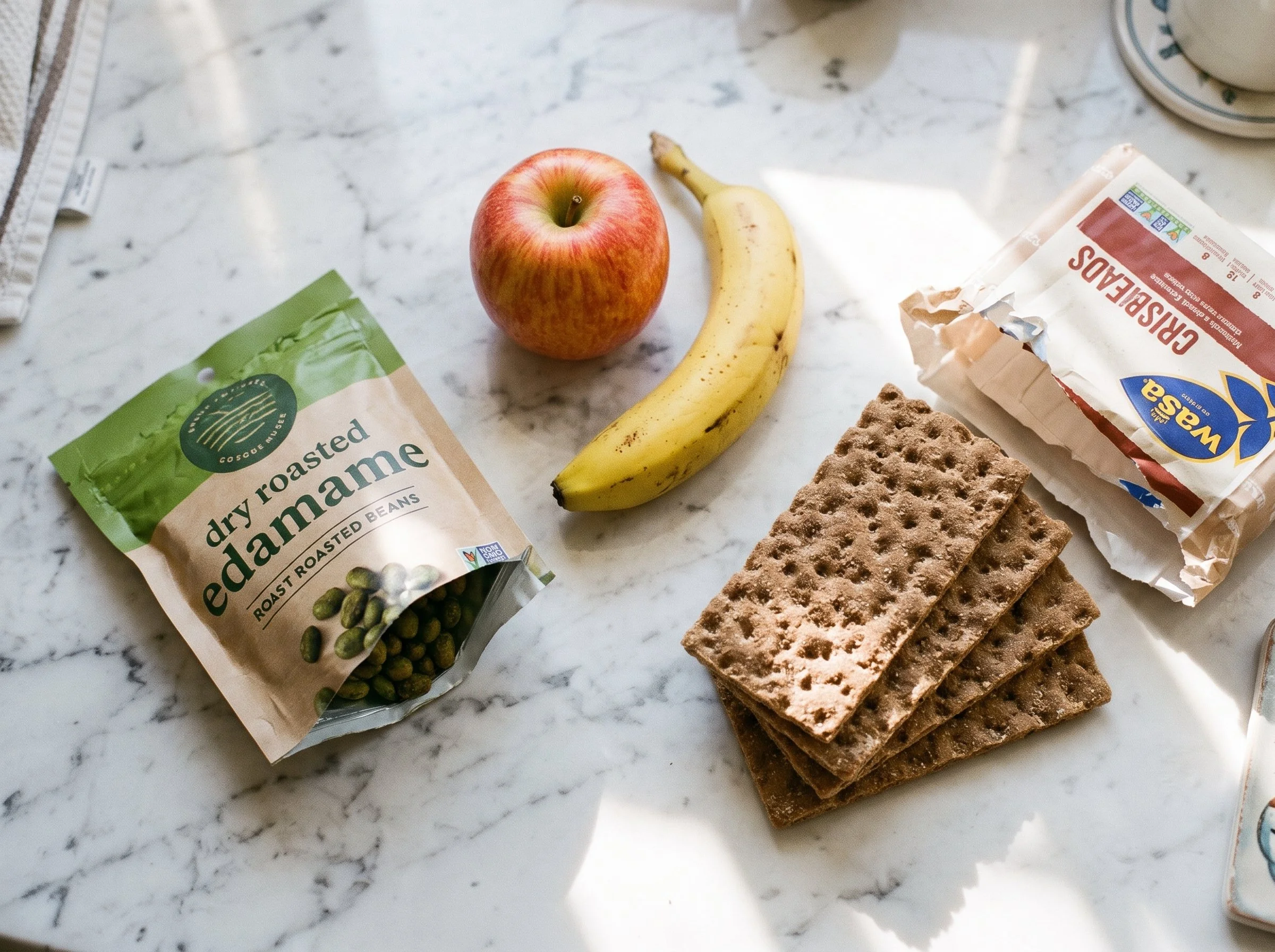
1. Dry roasted edamame. This is the snack you'll never catch me traveling without. A third of a cup of the sea salt version has 14 g of protein, 6 g of fiber, and 130 calories. It travels easily, and I sometimes toss it on a salad.
2. Pretzels. I get this question constantly: wheat gluten is not inherently a reflux trigger. If you have celiac disease or a gluten sensitivity, skip them. Otherwise, pretzels have virtually no fat, which makes them an easy base. Pair them with a protein like peanut butter, Greek yogurt, or a lower-fat cheese like a Babybel.
3. Crackers and crispbreads. Simple Mills veggie flour Himalayan salt crackers have no added garlic or onion powder, which matters when your esophagus is sensitive to spices. They taste a bit like a pita chip and pair well with hummus. I also love Wasa crispbreads: two slices have 60 calories and 4 g of fiber, and they're delicious with nut butter, with cottage cheese and cucumber, or alongside eggs. Fair warning, they make crumbs on a plane.
Fruit snacks: apples, bananas, and applesauce pouches
4. Apples. I always pack apples. They bring soluble fiber, which supports your gut. Apples range in acidity, so the variety matters. Gala apples tend to be lower in acid, and our clients tolerate them well. If Granny Smith feels too sharp on your throat, try Gala.
5. Bananas. Bananas are low in acid and rich in potassium. I pair one with a protein bar, a nut butter packet, or a handful of pumpkin seeds so the snack carries protein too.
6. Applesauce pouches. Fresh fruit isn't always easy to pack, so pouches earn a spot. Read the ingredient list and look for no added citric acid. If you have gastritis, GERD, LPR, or Barrett's esophagus, I suggest avoiding citric acid in liquid form, because it's intense on the throat. As the last ingredient in a bread product, it worries me far less.
Light and crunchy: popcorn, seaweed, and rice cakes
7. Popcorn. Popcorn is a whole grain and a good source of fiber. Three cups of the Lesser Evil brand has 130 calories and 4 g of fiber. Any lighter brand with no more than about 9 g of fat per serving works. Add pumpkin seeds, an egg bite, or a protein bar for staying power.
8. Seaweed snacks. These give you a crunchy, salty snack with gut health benefits. They're low in protein and fiber, so I treat them as something light to graze on rather than a full snack.
9. Caramel rice cakes. One rice cake has 50 calories and 3 g of sugar, and I love them as a quick carbohydrate before a run. For an afternoon snack where I want steady blood sugar, I add peanut butter or Greek yogurt on top, or crush one into a bowl of cottage cheese.

Dairy and bars: yogurt, protein bars, and homemade options
10. Yogurt. Dairy doesn't trigger reflux for most people, so I don't recommend eliminating it unless you notice symptoms. If you have a dairy allergy or sensitivity, skip it, because an unrecognized allergy can itself drive reflux symptoms. Dairy also brings calcium and vitamin D, which are worth protecting if you've been on a PPI long term. Some yogurts are more acidic than others. In the early healing phase, our more sensitive LPR clients sometimes find yogurt irritating, so we blend it into a smoothie with banana and almond milk or stir it into overnight oats to buffer the acidity. In my experience, Fage runs a bit acidic and Chobani is gentler. I like the Chobani vanilla zero sugar added protein yogurt.
11. Bars. I look for more protein than sugar and a little fiber, but not too much. Some bars, like Quest, carry 17 g of fiber. I call that a fiber bomb, and it can be a lot at once for a reflux-sensitive stomach. Three I recommend:
88 Acres banana bread bars: 12 g of protein, 3 g of fiber, 260 calories, and nut-free. A good pick when you need a more filling snack.
Vanilla almond RXBAR: 190 calories, 5 g of fiber, 12 g of protein.
GoMacro bars: some flavors are low FODMAP. The maple sea salt flavor has 270 calories, 36 g of carbohydrate, 2 g of fiber, and 11 g of protein, which makes it a fit for endurance athletes or anyone with gastroparesis who wants less fiber. The flavors I show contain no chocolate, peppermint, or lemon, which is part of why they work well for reflux-sensitive stomachs.
12 and 13. Homemade. My high-protein pumpkin muffins travel well, freeze for meal prep, and also work as little donuts. The FLORA App has protein bites, egg bites, homemade protein bars, and homemade hummus if you want recipes you can make ahead.
Put one snack to work this week
Pick one carbohydrate you already tolerate and pair it with a protein: crackers with cottage cheese, a banana with nut butter, popcorn with pumpkin seeds. Treat it as an experiment. Notice how your afternoon and evening feel for a few days, then adjust the pairing. Small hinges swing big doors, and a better snack at 3 p.m. is one of the easiest hinges to start with.
If you have LPR and want to go deeper, watch my full LPR deep dive on my YouTube channel.
Want a plan built around your own triggers and routine? Apply to work with our team of reflux dietitians.
With love,
Molly Pelletier, MS, RD

References
Holloway RH, Hongo M, Berger K, McCallum RW. Gastric distention: a mechanism for postprandial gastroesophageal reflux. Gastroenterology, 1985. Physiology study, n=33 (16 healthy, 17 with GERD). PMID: 4029557. DOI
Rana AK, Sharma R, Verma M, Singh AD, Mehrotra A. Efficacy of psyllium husk as an adjunct to PPI in treating laryngopharyngeal reflux: a clinical perspective. Indian Journal of Otolaryngology and Head and Neck Surgery, 2025. Prospective randomized study, n=505, 16 weeks. PMID: 40226240. DOI
This post is for educational purposes only and is not a substitute for personalized medical advice. Always consult your healthcare team before making changes to your routine.