The Ultimate Guide to GERD: The Full Root-Contributor Protocol I Used to Heal Chronic Reflux
If you have ever felt like every meal is a gamble, this guide is for you.
I know that feeling from the inside. Before I was The Reflux Dietitian, I was the person lying awake with a burning throat, googling symptoms at 2am, watching my list of "safe" foods shrink until there was almost nothing left on it. I was doing everything the internet told me to do. I cut the coffee. I raised the head of my bed. I took the medication. And I still was not getting better.
What finally changed things was not another food to remove. It was learning to support the system that was actually struggling. That is what this guide walks you through: the full picture, the way I teach it to my clients, and the way I wish someone had taught it to me.
This is a long one, so use the chapters to jump to what you need.
CHAPTERS
1. My Story: From Food Fear To Healing
2. Why "Just Suppress The Acid" Keeps Failing
3. Root Contributor #1: Your LES And Barrier Mechanics
4. Root Contributor #2: Your Nervous System
5. Root Contributor #3: How You Eat, Not Only What You Eat
6. Root Contributor #4: Strategic Addition Over Restriction
7. A Calm, Informed Word On PPIs
8. Where To Start This Week
1. My Story: From Food Fear To Healing
My reflux did not announce itself politely. It showed up and reorganized my entire relationship with food. Meals became something to fear instead of enjoy. I got very good at restriction, and restriction gave me a smaller and smaller world without giving me relief.
The turning point came when I stopped asking "what else can I take away?" and started asking "what is actually failing here, and how do I support it?" I leaned into the mechanics of digestion. I worked on how I was eating, not only what I was eating. I learned to calm my stress response so my body could actually digest. And I added in soothing support for irritated tissue. In my own healing, the soothing tool I reached for was a mucilaginous herb, slippery elm, which I later built into my own formula, Sequoia Soothe.
That combination is what gave me my life back. It is also the foundation of the work I now do with clients every day. You are not broken, and you are not doing this wrong. Your system is under-supported, and that is something we can work on together.
2. Why "Just Suppress The Acid" Keeps Failing
Most reflux advice starts and ends with acid. Lower the acid, lower the symptoms. For some people, for a while, that helps. For many of you reading this, it has not been enough, and there is a real reason why.
Reflux is rarely a single-cause problem. It has multiple, overlapping root contributors: the integrity of your lower esophageal sphincter (LES), the motility of your gut, the state of your nervous system, your hormones, your sleeping position, medication effects, and yes, your diet. Food is usually one of five to seven factors, not the whole story.
Acid suppression addresses one variable. It does not restore LES tone, improve motility, or calm an overactive stress response. That is why you can do everything "right" on the acid front and still feel stuck. Healing means rebuilding the architecture of a reflux-free esophagus, not indefinitely turning down a single dial.
There is one role of stomach acid worth understanding here, because it often gets oversimplified. Acid serves an important antimicrobial function. It helps neutralize ingested pathogens. Suppressing it long term is sometimes clinically appropriate, and it also comes with tradeoffs we will cover in chapter seven. The point is not fear. The point is a fuller picture so you can make informed choice.
3. Root Contributor #1: Your LES And Barrier Mechanics
Your LES is the ring of muscle that is supposed to keep stomach contents where they belong. When people are told their LES is "weak," it sounds permanent. In most cases it is far more under-supported than truly broken, and several of the things that support it are directly modifiable.
The LES Lock (diaphragmatic breathing). Your crural diaphragm wraps around the LES and acts like an external support for it. You can train it. This is one of my favorite tools because it is small and repeatable: 1 to 5 minutes of diaphragmatic breathing with 360-degree ribcage expansion, done immediately after meals, up to five times a day. Slow breathing through a fully expanding ribcage strengthens that crural diaphragm and supports LES pressure. These bite-size practices are more achievable than a big daily routine, and consistency is the secret sauce.
An alginate raft after trigger meals and before bed. Alginates are seaweed-derived compounds that form a gel raft floating on top of your stomach contents. That raft physically sits over the acid pocket and blocks backflow, which is especially useful after meals and overnight. This is barrier mechanics, not acid suppression. A raft I recommend is Reflux Raft, an alginate product you can take after meals or before lying down. According to PubMed, a systematic review and meta-analysis of 14 randomized controlled trials (N = 2,095) found alginate-based therapy significantly increased the odds of GERD symptom resolution compared with placebo or antacids (odds ratio 4.42, 95% CI 2.45 to 7.97) (Leiman et al., 2017, Diseases of the Esophagus, PMID 28375448).
Left-side gravity at night. Sleep on your left side with your head elevated 6 to 9 inches. This position tends to keep the LES in an air pocket above your stomach contents, which reduces overnight reflux events.
A loose waistline. Tight belts and high-compression clothing increase intra-abdominal pressure, and that pressure pushes gastric contents upward. Loosening the waistband is a genuinely mechanical intervention, not a comfort preference.
The 3-hour buffer. Give yourself roughly a 3-hour buffer between your last meal and lying down. This lets your stomach empty more completely so there is less volume and less pressure on the LES when you are horizontal. Beverages are fine in that window. This is a flexible guideline, not a rigid rule.

4. Root Contributor #2: Your Nervous System
Here is something my clients rarely hear from anyone else, and it changes everything once it clicks. Your digestive system works best when your body feels safe.
When you are stuck in fight-or-flight, blood flow shifts away from your gut, your diaphragm tightens, and LES coordination gets disrupted. This is the mechanism behind an experience you may already recognize. You can eat the exact same meal on two different days and react completely differently, simply because your stress levels were different. That unpredictability is not in your head. Your gut-brain axis plays a direct role.
The research is catching up to what the gut sees clinically. According to PubMed, a case-control study of 45 patients with laryngopharyngeal reflux versus 29 healthy controls found significantly higher anxiety (Hamilton Anxiety score 9.53 versus 6.79, p = 0.025) and higher perceived stress (PSS-10 score 21.62 versus 13.90, p < 0.001) in the reflux group (Barillari et al., 2025, European Archives of Oto-Rhino-Laryngology, PMID 40258993). Reflux symptom severity tracked with psychological distress. This is a smaller study, so I hold it as strong supporting evidence rather than the final word, but it lines up with the mechanism and with what I watch happen in real people.
Two practices I teach clients here:
The 5+1 Method (pre-meal). Before you eat, take 5 slow breaths and name 1 thing you are grateful for. This is a quick way to nudge your body into a parasympathetic, rest-and-digest state so digestion can actually happen. This is one of the practices we build into your protocol together.
The Nervous System Snack. A 1 to 5 minute nervous system break, one to three times a day. A longer exhale, humming, or a hand on your chest and belly while you breathe. Small, frequent regulation beats one big session you never get around to.
5. Root Contributor #3: How You Eat, Not Only What You Eat
Two people can eat the identical meal and have opposite experiences based on how they ate it. Mechanics matter.
Mealtime Mindfulness. Chew each bite to an applesauce-like consistency, slow down, and single-task while you eat. Chewing is not a small thing. It stimulates a large share of your digestive juice production and physically reduces the workload downstream. Try to avoid drowning your meal in liquid, which can dilute that process.
Coffee, changed rather than eliminated. You do not automatically have to give up coffee. You often just have to change the conditions. Four adjustments I use: always have it with food rather than on an empty stomach, keep it to one cup rather than three (volume matters), consider a low-acid blend or cold brew, and add a splash of milk or almond milk to buffer the acidity. Lower-pH coffee has been shown to reduce LES pressure more than neutral-pH coffee (Thomas et al., 1980, Gastroenterology, PMID 7002705), which is exactly why buffering and blend choice help.
6. Root Contributor #4: Strategic Addition Over Restriction
If you have spent months removing foods and feeling worse, please hear this clearly. Restriction alone does not rebuild the mechanisms that are failing. It does not heal your mucosa. It does not restore LES tone. It does not address pepsin sensitivity. And it does not improve your motility.
The more powerful question is what you can strategically add to support healing.
Fiber, used strategically. Soluble fiber can create a buffering matrix in the upper GI tract and support motility. According to PubMed, a prospective study of 505 patients with confirmed LPR found that psyllium husk added to a PPI produced an 82% symptom resolution rate over 16 weeks, higher than PPI plus a prokinetic (75%) or PPI alone (65%), with the fastest time to improvement (Rana et al., 2025, Indian Journal of Otolaryngology and Head and Neck Surgery, PMID 40226240). Here is what I teach my clients: fiber is not something you add as an afterthought. The question is whether you are using it strategically, in the right form, at the right time, alongside the rest of your protocol.
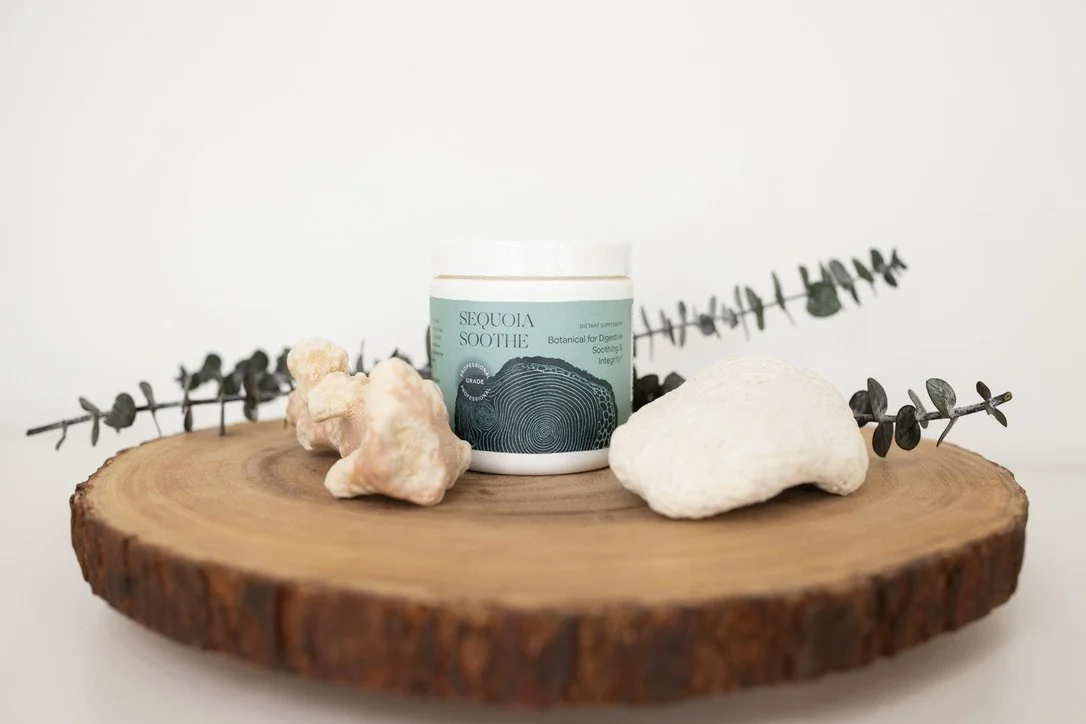
Soothing support for irritated tissue. When the tissue of your upper GI tract is irritated, soothing it can make the rest of the work more tolerable. This is the role slippery elm played in my own healing, and it is why I built Sequoia Soothe around mucosal support. The formula pairs slippery elm (1000mg) and L-glutamine (2500mg) with DGL (300mg), zinc carnosine (7.5mg), and copper (0.5mg). Its purpose is to soothe irritated tissue and support esophageal comfort, not to suppress acid and not a quick fix. Give any soothing approach a few weeks of consistency before you judge it.
7. A Calm, Informed Word On PPIs
Proton pump inhibitors are not the enemy, and I will never tell you to stop a medication out of fear. PPIs can be an appropriate part of a short-term strategy, and for certain conditions long-term use is genuinely warranted.
What I want you to have is informed agency. According to PubMed, the American Gastroenterological Association's best-practice review recommends that patients with uncomplicated GERD who respond to short-term PPIs should attempt to reduce or stop them, and that long-term users take the lowest effective dose with periodic reevaluation (Freedberg et al., 2017, Gastroenterology, PMID 28257716). Long-term acid suppression can also affect absorption of nutrients like vitamin B12, magnesium, and calcium (Fashner and Gitu, 2013, FP Essentials, PMID 24124705; Koyyada, 2020, Therapie, PMID 32718584).
None of that means panic. It means the goal is the lowest effective support for the shortest necessary time, with a real plan underneath you. If you want to reduce your dependence on a PPI, that is a supervised, gradual process, not a cold-turkey stop, because abrupt discontinuation can cause rebound acid hypersecretion. That is exactly what the PPI Exit Strategy is built for.
8. Where To Start This Week
You do not need to do all of this at once. Small hinges swing big doors.
Pick two things. I would start with the LES Lock after your largest meal each day, and the 3-hour buffer before bed. Layer in the 5+1 Method next week. Add an alginate raft after your known trigger meals. Let each practice become a habit before you stack the next one on top.
This is the work, and you deserve support that actually explains why your body is doing what it is doing and what to do about it. If you want the full protocol mapped to your specific situation, that is what we build together inside the Reflux Relief Masterclass, and for US-based clients, inside 1:1 counseling. The FLORA App has the guided breathing practices and reflux-friendly recipes to make the daily part easier.
You are capable of change, even if your symptoms have felt stuck for years. I have watched it happen for hundreds of people, and it happened for me.
xo, Molly