Tried Everything for Your Reflux? 10 Things to Do Before You Give Up
You cut the coffee. Then the tomatoes. Then the wine. You are on your second medication, maybe your third. You have read the forums, tried the supplements, done what the internet told you to do, and you are still lying awake at night wondering whether this is simply your life now.
I know that feeling from the inside. I lived it before I specialized in it.
Here is what I see in our practice almost every single week. Someone comes to us and says, "I've tried everything, and nothing works." When we actually walk it back together, they have not tried everything. They have tried a lot of different things once, or the same thing over and over, and somewhere in there they arrived at the conclusion that healing is not available to them.
It usually is.
There is almost always a path toward some level of relief, and it tends to run through a few specific pieces that most plans skip entirely. These are the 10 I ask every person to work through before they give up.
1. Confirm that reflux is actually what you are treating
This is the uncomfortable one, so I am putting it first.
I have worked with a lot of people who are locked onto reflux when reflux is a symptom of something else, or when it is not the primary thing happening at all. Someone can have reflux hypersensitivity, where the sensation feels exactly like reflux while the actual volume of reflux events sits in a normal range. That is a different problem, and it responds to a different approach.
This matters even more with LPR, or laryngopharyngeal reflux, the silent reflux that shows up in the throat and voice box. Those throat symptoms overlap with muscle tension dysphonia, with allergies, and with several other conditions that have nothing to do with acid at all.
If you are treating the wrong mechanism, no amount of consistency will produce a result. You can do everything perfectly and still not move.
Verifying what you are actually dealing with is worth the appointment.
2. Delete the belief that you will never get better
If you are telling yourself there is no future where your symptoms stop running your day, I want that thought out of your head. Not as a mindset exercise. As a clinical intervention.
That belief keeps your nervous system parked in sympathetic fight-or-flight. When you live in fight-or-flight, your vagus nerve, the gut-brain communication pathway, is affected. Your vagus nerve has a direct influence on your lower esophageal sphincter, which is your anti-reflux barrier, and on digestive juice production. Your digestion gets deprioritized by a body that thinks it has bigger problems.
The research keeps pointing here. According to PubMed, a 2025 case-control study of 45 patients with laryngopharyngeal reflux compared to 29 healthy controls found significantly higher anxiety, depression and perceived stress in the reflux group, with perceived stress scores of 21.62 versus 13.90 (Barillari et al., 2025, European Archives of Oto-Rhino-Laryngology, PMID 40258993, DOI).
So start building the version of you who is better. A short morning meditation. Deep breathing spread through the day. When the "this is permanent" thought shows up, notice it and swipe it away like you are clearing a notification off your lock screen.
And I believe in you. That part is not filler.
3. Build a protocol, not a pile of tips
Sit down and ask yourself an honest question. Are you following a plan, consistently, or are you collecting tips and doing them sometimes?
Those are different things and they produce different results.
Build something sustainable and realistic that you can actually follow through the week. A daily checklist works well here. Supplements in. Breathing in. Nutrition in. Check, check, check. If you stay consistent long enough, you get results.
Consistency is the secret sauce, which is exactly why the plan has to be small enough to keep.
4. The Sunday Special
Twenty minutes, every Sunday, planning your nutrition and your week.
If you know your schedule is packed and you need lunches prepped, prep them. If you know Wednesday is a late night and you will not have the energy to cook, get dinner made ahead so you can warm it up and still eat inside your 3-hour buffer, meaning food finished about three hours before you lie down. Beverages are still fine.
Twenty minutes on Sunday removes the decision you would otherwise have to make at 8pm on Wednesday, when you are exhausted and the only thing in the house is the food that always gets you.
That is the whole point. You are not trying to have more willpower on Wednesday. You are trying to need less of it.
5. Get honest about where you are slipping
This is the tough love section.
When you do not stick to the plan you built, whether it is supplements, nutrition, or something a provider gave you, ask yourself what actually happened. Then address that specific reason instead of restarting the same plan and hoping for a different outcome.
Sometimes the answer is that you need accountability. That might be a friend. It might be logging your meals and habits in the FLORA App, including your LES Lock. Here is what I teach my clients with the LES Lock: 1 to 5 minutes of diaphragmatic breathing with a full 360-degree expansion of the ribcage, immediately after eating, up to 5 times a day. It strengthens the crural diaphragm and supports the pressure barrier that keeps stomach contents where they belong. Bite-size and repeatable beats ambitious and abandoned.
Some people also find a soothing tool helps them stay consistent through the harder stretches. Mucilaginous slippery elm was mine, which is why I built it into Sequoia Soothe alongside DGL and zinc carnosine to soothe irritated tissue and support esophageal comfort. It made the hard days more livable while the real work did its job.
You cannot fix what you are not willing to look at honestly.

6. Walk after your meals
Simple, overlooked, and it helps a lot of our clients.
Reflux at its root involves motility, the movement of food through your digestive tract. If you have eliminated the foods and taken the supplements and you are still not seeing benefit, motility may be one of your root contributors. Gentle walking after meals supports it.
According to PubMed, a 2025 systematic review of 231 studies found that regular moderate-intensity exercise, including walking, is associated with improved gastrointestinal function in conditions including gastroesophageal reflux disease, with enhanced intestinal motility named as one of the mechanisms (Al-Beltagi et al., 2025, World Journal of Gastroenterology 31(22):106835, PMID 40539198, DOI). An earlier controlled study using pH-metry found that one hour of walking after a meal reduced postprandial acid contact time in people with reflux, though the effect was mild and short-lived (Avidan et al., 2001, Alimentary Pharmacology & Therapeutics 15(2):151-5, PMID 11148431, DOI).
A walk also clears your head and lowers stress, which supports the nervous system piece from tip 2 and makes you more likely to stay consistent. Several benefits, one habit.
7. Stop ignoring your vagus nerve
If you have eliminated the foods, you are taking the supplements, and you are being consistent, this is usually the one that is still missing.
Your vagus nerve regulates your entire digestive process. It helps close the lower esophageal sphincter at the right times. It supports digestive juice production. It supports motility. Your gut and your brain are in constant communication, and when your nervous system is dysregulated, your digestion is too.
The practices I use and teach are the unglamorous ones: extended exhales, diaphragmatic breathing, and a hand on your chest or belly while you breathe. Daily, in small doses.
8. Visceral hypersensitivity, the piece almost nobody explains
This is the one I most want you to know exists.
Your symptoms may not always be active reflux. They can be the nerves of your digestive system, larynx or esophagus staying hypersensitive after the fact. Previous reflux lit up those nerves, and they never fully turned the volume back down.
If you are feeling symptoms 24/7, or you have been at this for months and months and it feels like even water triggers you, visceral hypersensitivity is worth raising with your provider by name.
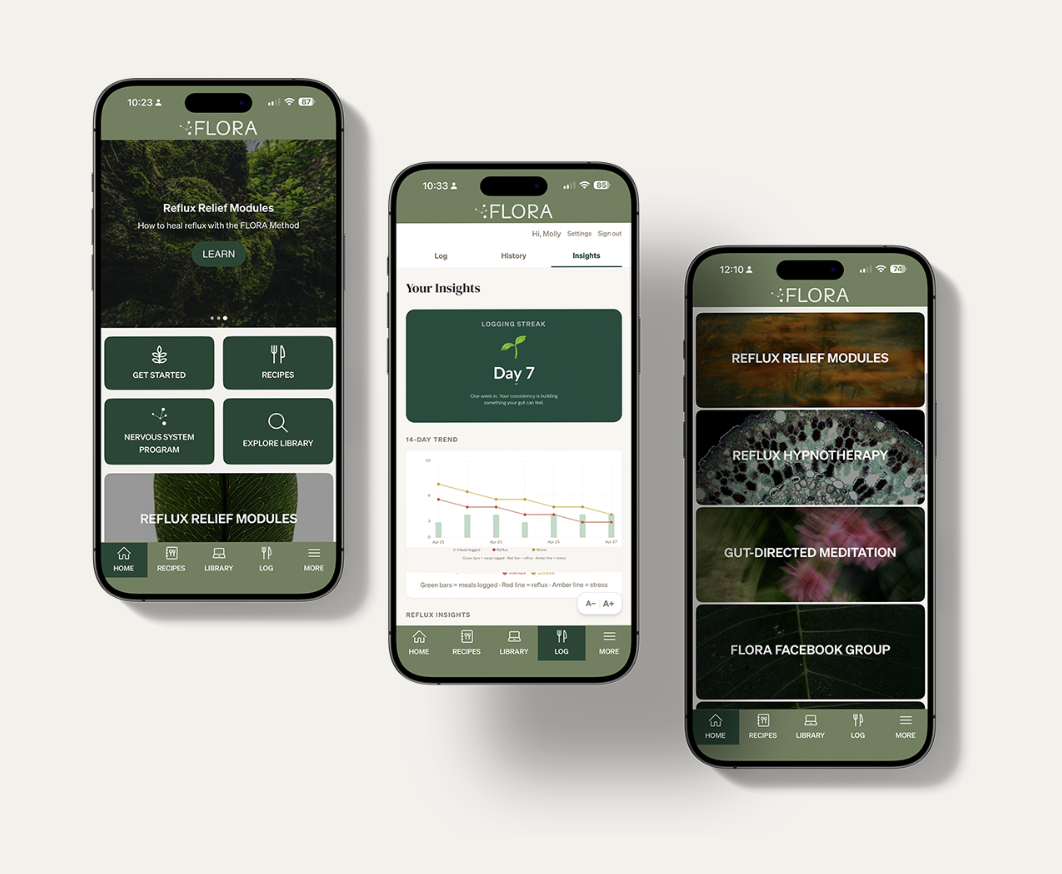
There are options. Daily vagus nerve support helps. Reflux hypnotherapy, which we have in the FLORA App, helps. And there are medication options in a class called neuromodulators, which work by turning down the sensitivity of those nerves rather than suppressing acid. This is well established enough that the 2025 Italian multi-society consensus guidelines on GERD, developed through a Delphi process across five gastroenterology societies, voted in favor of neuromodulators for treating visceral hypersensitivity in refractory reflux (Savarino et al., 2025, Digestive and Liver Disease 57(8):1550-1577, PMID 40450492, DOI), according to PubMed.
That is a conversation for you and your provider. But you cannot have it if nobody has told you the category exists.
9. Ask for help
The instinct is to handle this quietly. I understand it, and it was one of my biggest mistakes.
Asking for help might look like asking your partner to take on some of the cooking or the meal prep. It might look like asking a friend to go for a walk with you when you are overwhelmed and scared. Walking with someone you love is its own kind of medicine.
When you isolate yourself, you send your nervous system a message that you are not safe and that you are sick. That is the opposite of the signal we want, and it loops right back into everything in tip 7.
Let people in. Explain what you are going through and tell them specifically how they can help. Most people are relieved to be asked.
10. Give it a real timeline
Healing is not a straight line, and it takes time.
You will have one great week and then a stretch that feels like two steps backward. That is normal. You did not lose your progress, you are getting more information from your body.
The biggest mistake I watch people make is not giving their body enough time before deciding it failed. When you start a new plan, give it at least a few weeks, ideally a month. If your reflux has been going on for months, years or decades, it will not resolve in seven days. Mine took longer than it needed to, because I spent so long piecing together random tips on my own instead of following one plan.
Where to start this week
If you take nothing else from this, take this: you are not broken, and there is almost always a path forward toward relief.
Build a plan that is realistic and evidence-based. You can assemble one from my free Reflux Revolution Guide and my free 14-Day Reflux Reset. Then be consistent with it, give it real time, and invite people into it with you.
Small hinges swing big doors.
If you want the structure built for you rather than assembled from scratch, that is exactly what we map out together inside the FLORA App and in our 1:1 coaching. And if your symptoms live mostly in your throat, watch my ultimate guide to laryngopharyngeal reflux next so you know what your specific next step is.
Then come tell me which number you are starting with. I read them.
Ready to stop piecing it together alone? Explore the FLORA App or apply to work with us 1:1 at here.
xo,
Molly